Stay updated!
The best customer experience content delivered right to your inbox.
Pay for Conversations, Not Complexity: UJET's AI-First Pricing

AI changed how contact centers work. It did not change how most of them are priced.
CX leaders now run a mix of human agents, virtual agents, agent assist, and analytics. Yet they still buy that mix the old way: seats from one vendor, minutes from another, tokens from a third. Each model made sense for the tool it was built for. Together, they produce a monthly bill no one can predict and no one can tie to results.
That is why we recently rebuilt UJET pricing from the ground up. Every package includes AI. Every session is priced the same way, whether a virtual agent, a human, or a mix of both handles it. And it's all based on the thing that contact centers have been forecasting for decades: interaction volume.
TL;DR
UJET's AI-first pricing removes four common budget problems at once:
-
Seat-based pricing that disconnects cost from volume
-
Consumption pricing that makes usage unpredictable
-
Token pricing that hides model costs
-
Outcome pricing that leaves buyers arguing over definitions
Every CX & AI package includes AI, every session is priced the same way, and finance teams can forecast on interaction volume instead of juggling multiple meters.
Four pricing models. Four ways to lose control of the budget.
Most CX vendors price one of four ways. Each solves one problem and creates another.
Seat-based pricing: you pay for headcount that may not map to volume
Per-seat pricing was built for a world where every conversation needed a person. In the AI era, it works against you. As virtual agents resolve more conversations, you need fewer seats. That misalignment shows up in renewals, in bundled minimums, and in AI sold as a costly per-seat add-on.
Seats also say nothing about value: a seat costs the same whether it handles 50 conversations a day or five, and whether the agent logs in or not.
Consumption-based pricing: you pay for activity, even the unpredictable parts
Per-minute and per-message pricing tracks usage, which sounds fair until volume moves. A longer call costs more even when it was a worse experience. A conversation that crosses from chat to voice is billed twice under two meters. Peak seasons, promotions, and unpredicted spikes turn a monthly budget into a monthly surprise, and finance teams cannot reconcile the bill to anything a customer actually experienced.
Token-based pricing: you pay for model behavior you cannot see
Token pricing passes the economics of large language models directly to the buyer. The problem is that tokens depend on things buyers do not control: prompt design, model choice, context length, retries, feature use, and how often a vendor upgrades its models.
You'd need a PhD to forecast some platforms that are using token-based pricing. As AI usage grows, token risk grows with it, and the budget breaks precisely when the program starts to succeed.
Outcome-based pricing: you pay for a definition someone else writes
Outcome or per-resolution pricing promises alignment, and the intent is right. In practice, the vendor defines what counts as an outcome (most of the time, whether a conversation was contained in self-service), measures it in its own system, and bills against it.
Disputes will follow: are we engineering for the right outcomes? You could contain 100% of conversations with virtual agents, but that doesn't necessarily mean customers get what they want, and it surely doesn't mean CSAT will be high. If a customer calls to cancel service and you contain it without attempting to have a human agent retain them, is that really an outcome you want to be paying for? We've heard from a lot of vendors and their customers that outcome-based models result in one thing: debating if they're paying for the right outcome. Good luck forecasting this one too!
The result: four meters, no single view of cost
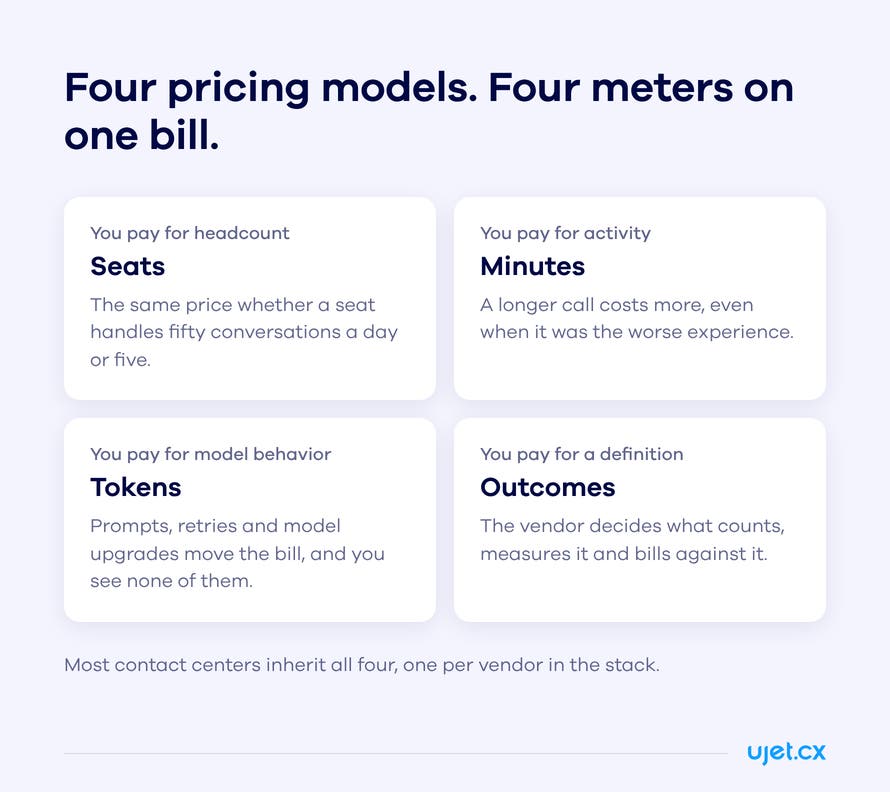
Most contact centers do not pick one of these models. They inherit all four, one per vendor in their software stack. The result is CX infrastructure with too many systems, too many pricing models, too much token risk, too little consolidation, and a complete inability to forecast spend.
CX leaders want fewer vendors, unified platforms, and one bill they can tie back to results.
Introducing UJET CX & AI packages: pick a bundle, choose how you pay
UJET pricing starts from a simple premise: AI is not an add-on, it is part of every package. Customers choose how much automation they want, not which products and pricing models they need to stitch together.
The CX & AI packages build on each other:
|
Package |
What's included |
Starting from |
|---|---|---|
|
Pro CX |
The omnichannel CX platform, with live transcription and summarization built in |
$0.377/session or $129/user/mo |
|
Voice AI |
Pro CX plus a virtual agent and agent assist on voice |
$0.65/session or $0.13/min |
|
Pro AI |
Pro CX plus a virtual agent and agent assist on every channel |
$0.65/session |
|
Enterprise AI |
Pro AI plus Conversational Analytics and enterprise support |
$0.715/session |
That's it. Every bundle can use as much or as little AI as it needs to deliver great CX, at a single price point.
For teams that want to start smaller, Conversational Analytics and UJET's CX Platform are also available as standalone products, with add-ons for channels and telephony.
See every package, entry price, and add-on on the UJET pricing page, and learn more about how UJET prices its commercial models.
How UJET pricing is different
AI-first: automation is included, not upsold
Every CX & AI package includes AI. There is no per-seat AI surcharge, no separate AI contract, and no second vendor to integrate. Customers decide how far to automate, and the platform is ready on day one.
Outcomes and value: cost follows conversations, not headcount
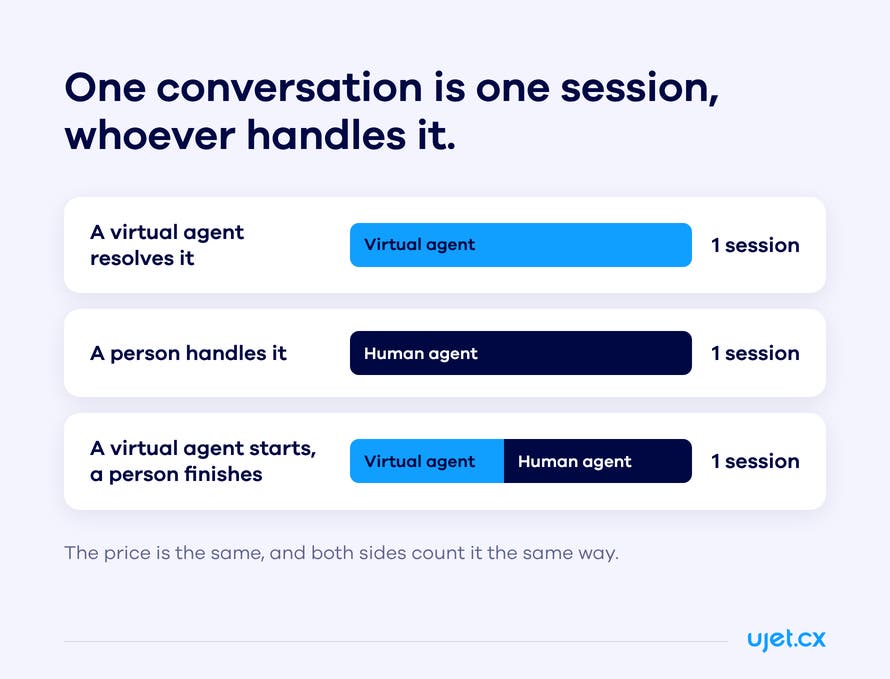
A session is one complete conversation, start to finish. It does not matter whether a virtual agent resolves it, a human handles it, or the two work together. The price is the same. This removes the disputes that come with vendor-defined "outcomes": a session is a session, counted the same way on both sides. Predictable and easy to forecast.
Predictable: no token risk passed to the customer
UJET absorbs the variability of AI models. Customers never pay more because a prompt got longer, a model was upgraded, or a conversation needed a retry. Finance teams forecast on session volume, a number they already track, instead of token consumption, a number they cannot see.
The forecasting unit is interaction volume, the same metric contact centers have tracked for decades.
Flexible: start where you are
Start with one product or one package. Add channels, AI, and analytics as needs grow. Choose the pricing model that makes sense based on how the business runs today, and change as it evolves.
Pricing that grows with your AI, not against it
The contact center has changed. Customers move between AI and humans in a single conversation, and CX leaders are expected to show the return on every automation dollar. Software pricing should make that easier, not harder.
UJET CX & AI packages replace four meters with one. AI is included. Sessions follow results. Budgets hold as automation grows.
Not sure where to start? Share your channel mix and monthly volume, and our team will recommend the right bundle. Or see AXO on your own stack: a 30-minute, line-by-line review of your current spend. Keep the humans. Cut the software.
Explore UJET pricing · Talk to an expert
Frequently asked questions
What is a session?
A session is one complete customer conversation on any channel, handled by any mix of AI and human agents. If a virtual agent starts the conversation and hands it to a person, it is still one session.
How much does UJET cost?
UJET's CX & AI packages start from $0.377 per session (Pro CX), $0.65 per session (Voice AI and Pro AI), and $0.715 per session (Enterprise AI), at Platinum-tier list rates. Pro CX is also available from $129 per user per month, Voice AI from $0.13 per minute of talk time, the standalone CX Platform from $65 per user per month, and Conversational Analytics from $2K per month.
Does every UJET package include AI?
Yes. Every CX & AI package includes AI. Pro CX includes live transcription and summarization. Voice AI and Pro AI add a virtual agent and agent assist. Enterprise AI adds Conversational Analytics and enterprise support.
Will I pay for AI tokens?
No. UJET does not pass token costs to customers. Your cost is based on sessions, subscriptions, or minutes depending on the model you choose, never on how many tokens a model consumes.
Can I still buy per agent/per month licensing?
Yes. Subscription pricing, per agent/per month, is available for Pro CX and the standalone CX Platform. It suits teams that want a fixed, predictable budget.
What if my contact center is mostly voice?
The Voice AI package is built for voice-first teams and can be priced per session or per minute of talk time.
Can I start with one product and add more later?
Yes. Start with the CX Platform, Conversational Analytics, or any package. Add channels, AI, and analytics as you grow, without re-platforming or re-papering.
What do the "from" prices on the pricing page mean?
"From" prices are the lowest list rate for each option. Bundle rates shown are for the Platinum tier. Your final price depends on volume, channels, and commercial model.
Can I get a custom quote?
Yes. Our team will build a quote around your volumes and channel mix. Contact us to get started.
The best customer experience content delivered right to your inbox.