Stay updated!
The best customer experience content delivered right to your inbox.
AI orchestration vs. workflow automation: the difference that shows up on the invoice


Workflow automation moves a task between systems you already pay for. AI orchestration decides, during the conversation, which systems need to exist at all. One adds a step to the stack. The other takes systems off the invoice.
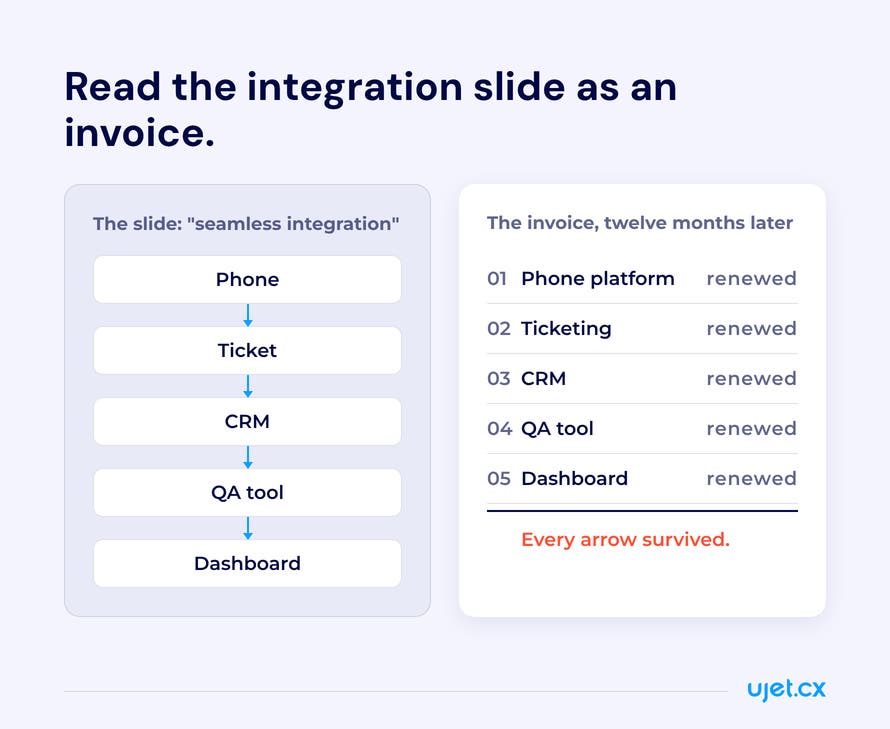
Every vendor deck in this category has a slide with arrows on it. The arrows go from the phone to the ticket to the CRM to the QA tool to the dashboard, and the slide is titled "seamless integration." Read it again as an invoice. Every arrow is a line item that survived.
What does workflow automation actually do?
Workflow automation executes a sequence that somebody defined in advance. A trigger fires, a rule routes, a bot copies a field, and a step that used to cost an agent forty seconds of clicking now happens in the background: when a chat closes, open a case; when the case is tagged billing, send it to the billing queue; when the call ends, paste the summary into the ticket. Robotic process automation is the same idea pointed at screens, replaying the clicks a person would have made in a system that never got an API. All of it is useful, and most contact centers have been running on some version of it for a decade.
The key word is "between." Workflow automation operates between systems, which means it takes the systems as given: it assumes every one of them is correct, necessary and permanent, and treats connecting them faster as the whole job. That is the design and there is nothing wrong with it as far as it goes, but it also means the one question automation can never ask is whether the stack it is making work harder is the right stack.
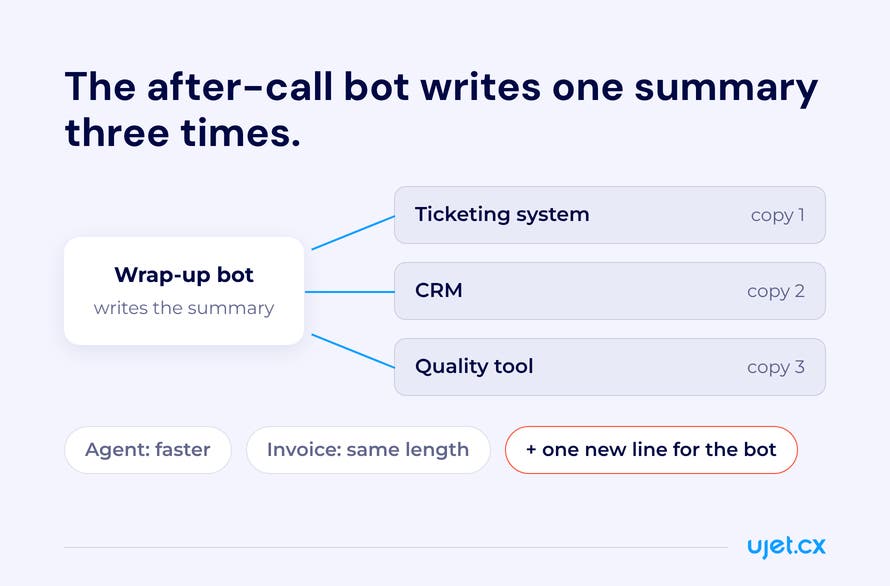
The after-call bot is the clearest example. A contact center buys an assistant that writes the wrap-up summary on its own, which is a real saving in agent time, and then configures it to write that summary into the ticketing system, the CRM and the quality tool, because each of those systems has an owner, a renewal and a report that depends on it, and nobody in the room had the authority to let one of them die. The summary is now written three times by a machine where it used to be written once by a person. The agent is faster, the invoice is the same length it was, and there is one new line on it for the bot.
What does AI orchestration do differently?
AI orchestration sits across the interaction while it is happening and acts on the record directly. It pulls the customer's context from the unified profile before the conversation starts, carries that context from the virtual agent to the human agent without a handoff that resets it, executes the refund or the address change or the claim inside the back-office system while the customer is still on the line, and writes the outcome to the system of record when the conversation closes, so there is no wrap-up left to automate and no second copy left to sync. Agentic Experience Orchestration (AXO) is UJET's name for that layer, and the day-one difference is the one the agent feels: they work in one desktop that already sees the customer, and the systems behind that desktop stop being their job.
The second difference is the one finance feels over the following year. Once a system is no longer where the work happens, it has to justify its line item on other grounds, and most of them cannot. A quality tool that scores a sample of calls has no case to make against an analytics layer that already reads every conversation, which is where quality management and workforce management are going inside Spiral, UJET's conversational analytics. The CRM is the biggest of these boxes. The CRM became the place the customer record lived because there was no CDP or data lake when it was invented, and now that there is, the CRM is an extra transit point holding a second copy of the record. You will not need it after AXO, and it comes off the invoice when the contract does, on your clock. Nobody rips a CRM out on day one. Your team stops working inside it on day one, and the renewal is your call.
Why does the difference only show up on the invoice?
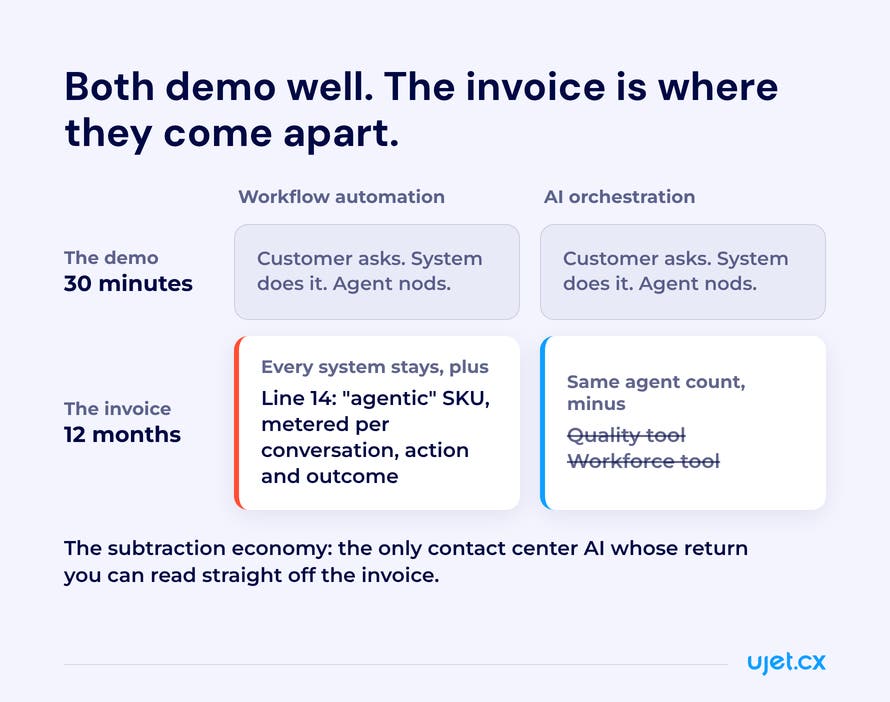
Because both demo well. In a demo, workflow automation and AI orchestration look almost identical: the customer asks for something, a system does it, the agent nods. The demo is thirty minutes long and the invoice is twelve months long, and the two technologies come apart on the second timescale.
A year after the automation project, the stack has every system it started with, plus an "agentic" SKU that turned out to be metered per conversation, per action and per outcome, and the invoice has grown a line 14. A year after the orchestration project, the same operation has stopped renewing a quality tool and a workforce tool, because the work those tools did now happens inside the layer that runs the conversation, and the agent count is where it was or higher. UJET's CEO Vasili Triant calls the second outcome the subtraction economy, and it is the only version of contact center AI whose return you can read straight off the invoice.
Analysts are seeing the first outcome more often than the second. Frost & Sullivan's 2026 analysis of the North American CX platforms market found organizations consuming more AI than they expected, at a cost that keeps rising, for returns that have stayed limited, and some of the companies that reduced headcount are hiring people back. Metrigy's research puts the leading cause of AI project failure at data fragmentation, which is another way of saying the AI was dropped onto a stack where the context it needed was scattered across systems that were never designed to share it. Automation inherits that fragmentation and builds a faster path around it, while orchestration is the decision to stop routing around it at all.
How do you tell which one a vendor is selling you?
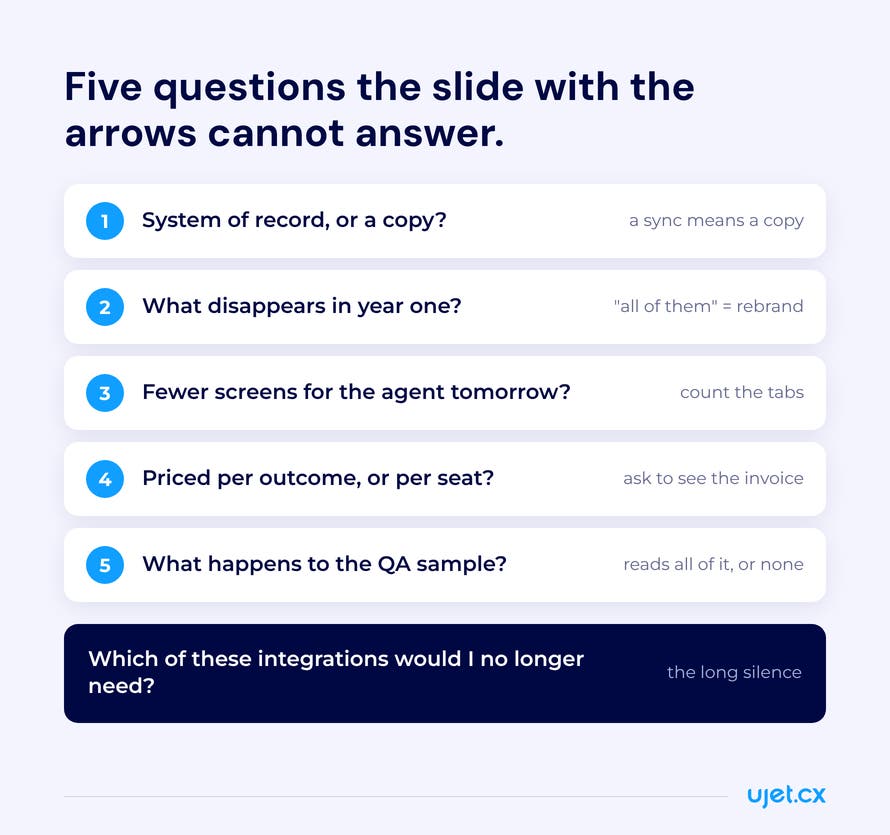
Five questions for the demo, because the slide with the arrows will not answer any of them.
Does it write to the system of record or to a copy? If the answer involves a sync, a connector or a nightly job, the vendor has added a box to the diagram and called it integration. Orchestration reads from and writes to the profile your business already treats as the truth, in your CDP or data lake, while the interaction is still open.
What disappears in year one? Ask whether the orchestration layer can eliminate any tool currently in your stack, and ask them to name the first one. If the answer is that it integrates with all of them, you are looking at workflow automation with a rebrand, and the slide with the arrows will have every box on it that it has today.
Can the agent see fewer screens tomorrow? Ask to watch a conversation where the AI changed course mid-interaction because of something the customer said, then count the tabs the agent still had open when it ended. If the demo needs a pre-scripted scenario to work, it is a workflow, and if the tab count is the same after go-live as before, the agent has been handed a faster way to swivel.
Does the "agentic" SKU price per outcome or per seat? Ask to see the pricing the way it will look on an invoice, because the slide will not show it. Per-conversation, per-action and per-outcome meters are how an "included" line becomes eight lines by renewal, and a vendor who cannot show you the shape of the bill is asking you to find out in year two.
What happens to the QA sample? If quality still means a reviewer listening to a few percent of calls after the AI is in, the AI is not reading the conversation. Orchestration runs on a layer that reads all of it, which is why the standalone quality tool is usually the first thing to go.
If the demo runs long, there is one question that covers all five. Point at the integration slide and ask which of those integrations you would no longer need if the orchestration was working correctly. That question tends to produce a long silence.
Is workflow automation ever the right call?
Yes, and often. A regulated process with fixed steps is a workflow automation job. So is a small operation whose volume would never justify an orchestration layer. And so is any stack you are contractually stuck with until 2028.
The honest move in those cases is to automate the handoffs you cannot remove yet and put the renewal dates on a calendar. Orchestration is a decision about which systems exist. If you cannot change which systems exist for the next two years, automation is how you get through them well. The mistake is buying automation and calling it orchestration, because the invoice will tell you the difference before anyone else does.
Frequently asked questions
Is AXO workflow automation?
No. Workflow automation executes steps defined in advance between systems that all stay. AXO is the orchestration layer that decides, during the conversation, what the next step is and which system it happens in, with a human in the loop. Individual steps still get automated inside it, and Computer-Using Agents carry out multi-step work in back-office systems, including ones with no API, but the layer deciding the steps is what makes it orchestration.
Does AI orchestration replace the CRM?
Yes, on your clock. Your CDP or data lake is the unified customer profile, and the CRM becomes an extra transit point holding a second copy of the record. AXO reads from and writes to the profile, your team stops working inside the CRM on day one, and the CRM comes off the invoice when its contract comes up. The plain-English AXO FAQ covers what happens to the CRM in more detail.
Does AI orchestration replace agents?
No. The person on the headset stays and works in one desktop that already sees the customer, and the roles that fade are the ones that existed to look after the stack. Frost & Sullivan's 2026 finding that some organizations which cut agents for AI are now hiring them back is the receipt. UJET's position is keep the humans and cut the software.
What does AI orchestration cost?
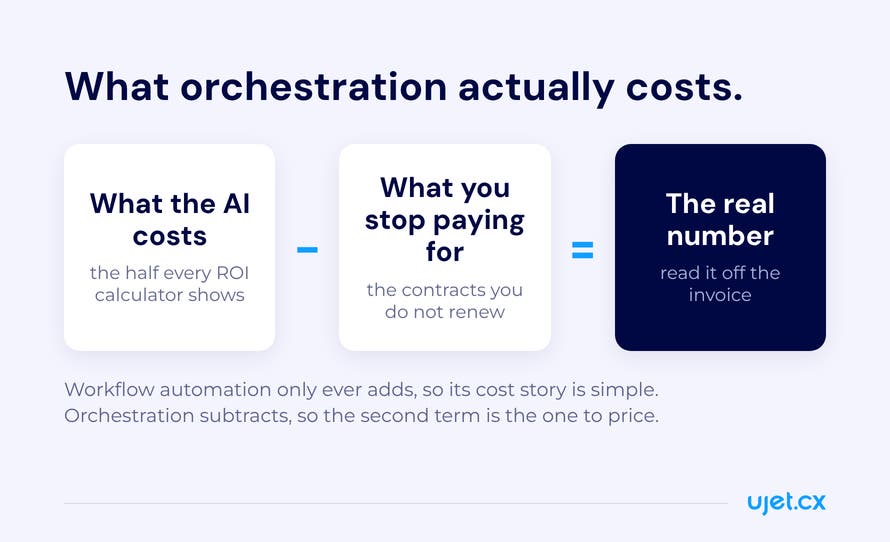
It depends on what comes off. Workflow automation has a simple cost story, because it is only ever added. Orchestration has a harder one, because the real number is what the AI costs minus what you stop paying for, and most vendor ROI calculators only show the first half. Run your own agent count and cost base through the UJET contact center ROI calculator for the first half, then set that result against the systems and contracts you will stop renewing before you take a number from anyone's slide.
How is AI orchestration different from an AI assistant?
An AI assistant listens to the conversation and recommends what to do next, and the agent still navigates the tools, performs the tasks and closes the ticket. Orchestration carries out the work itself, across the systems, while the conversation is live, and keeps the human in the loop to monitor and step in, which also makes it the thing that decides what the agent desktop still needs to contain.
In short: Workflow automation moves tasks between the systems you already pay for, and it presumes every one of them stays. AI orchestration acts on the record during the conversation and decides which systems still need to exist, which is why it is the version of contact center AI whose return shows up on the invoice. Agentic Experience Orchestration (AXO) is UJET's orchestration layer. Start with Spiral, let quality management and workforce management follow it, and let the CRM come off when the contract does.
The best customer experience content delivered right to your inbox.
About the authors