Stay updated!
The best customer experience content delivered right to your inbox.
What is Agentic Experience Orchestration (AXO)? A plain-English FAQ


Agentic Experience Orchestration (AXO) is UJET's end-to-end contact center platform where agentic AI acts across every system while the customer interaction is still happening, in self-service or with a live agent, running virtual agents, the agent desktop, analytics, quality and workforce management off one unified view of the customer.
AXO is how UJET transforms contact centers into Experience Centers that run as a revenue engine for the business. It is built for what UJET CEO Vasili Triant calls the subtraction economy, where the next gains come from taking systems out of the contact center, and the rest of this page answers the questions people ask most, in the order they usually ask them.
What does "agentic" mean in a contact center?
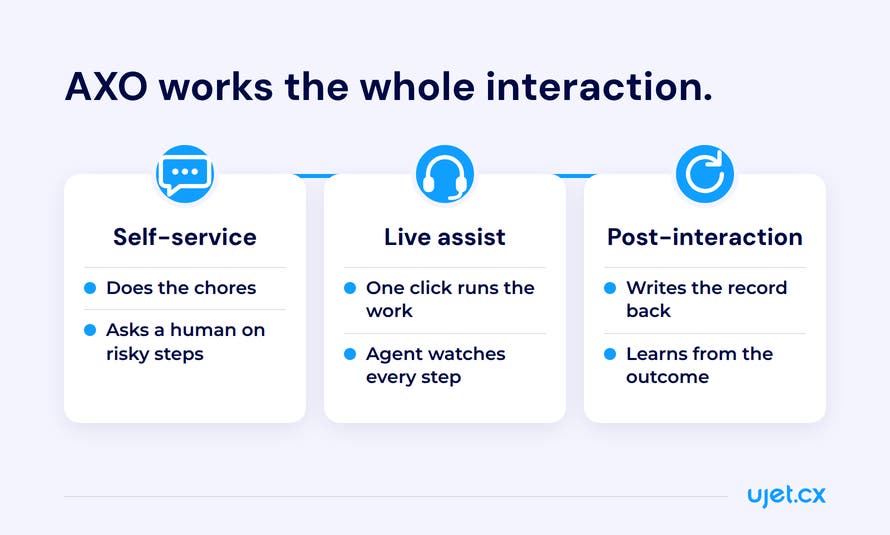
An agentic system can look something up, make a decision and carry out the next step across the stack while the interaction is still happening, whether the customer is in a self-service channel or on the line with an agent, which is a bigger job than suggesting a reply. Most contact center AI today already sits inside the interaction as a self-service bot or as agent assist, and both mostly answer or recommend. Agentic Experience Orchestration takes the action itself, in self-service and in live assist, and keeps working after the interaction closes, when it writes the record back and learns from the outcome.
What is inside AXO?
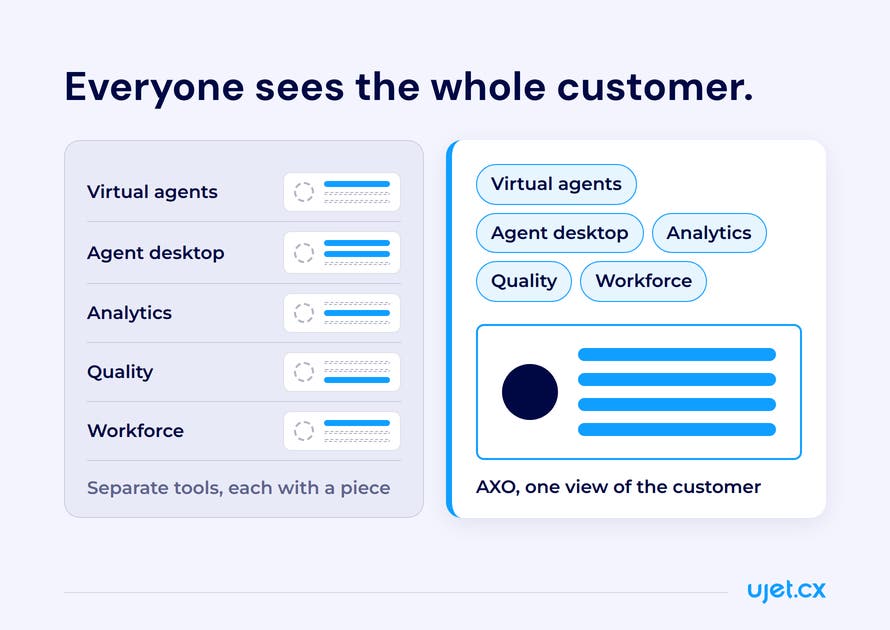
AXO puts agentic virtual agents, an agent desktop with AI assistants, conversational analytics, quality management and workforce management on one platform. Every part runs off a single, unified view of the customer, so no system has to pass notes to another one to know who is calling or why. That matters because a lot of organizations are already modernizing around one customer profile in a CDP or data lake, and many of them run more than one CRM, so AXO works from the profile you are already building, wherever it lives.
How does AXO work during a live interaction?
-
Virtual agents take the front of the conversation. They capture what the customer wants, verify who they are and do the chores, carrying out complex, multi-step actions across several tools on their own. When the AI judges a step to be risky, it alerts a human in the loop who can approve the flow or the response before it goes ahead, and it brings in a human agent when the conversation needs judgment.
-
The AI stays in the conversation after the handoff. The human agent gets a real-time summary, the customer's context from the unified profile and suggested replies, all inside the same desktop, so nobody goes hunting across tabs.
-
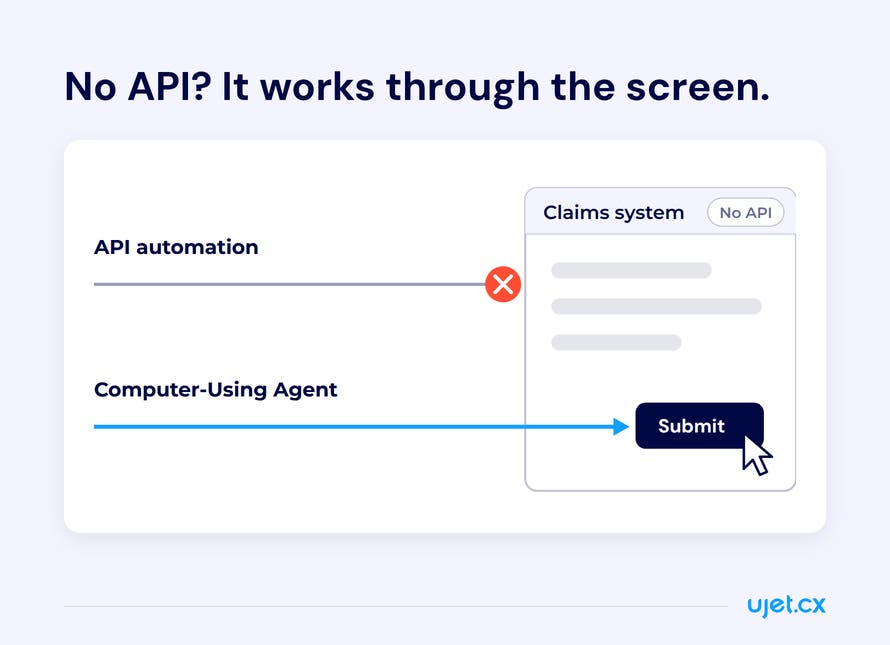
The agent triggers the work with one click. Computer-Using Agents then carry out the workflow across back-office systems, including systems with no API, for jobs like filing a claim or processing a refund. The agent can see every step as it runs, which keeps a human in the loop the whole way through, and that visibility is something customers keep asking for, since most automation of this kind runs invisibly behind the scenes.
-
The record writes itself when the interaction closes. AXO writes the summary and interaction databack to your CDP or data lake automatically, so the agent moves to the next customer without a round of manual wrap-up.
-
The platform learns from every outcome. AXO's conversational analytics engine reads 100% of conversations, and the automated flows are refined based on what actually resolved the customer's issue.
"Rather than relying on AI assistants to tell the human agents what to do next, AXO empowers them to easily execute autonomous workflows with a simple click of a button." (UJET, 11 March 2026)
What are Computer-Using Agents?
Computer-Using Agents are the part of AXO that carries out work inside back-office systems by operating the interface the way a person would. Traditional automation needs an API to connect to a system, and many of the systems contact center agents touch most often are older platforms that never had one, which is why automation in most contact centers has stayed partial. Because Computer-Using Agents work through the interface itself, a workflow can run in those systems whether or not they support integration, and the agent who triggered it can watch it run and step in at any point.
How is AXO different from agent assist?
Agent assist listens to the conversation and recommends what to do next. The agent still has to navigate the tools, perform the tasks and close out the ticket. AXO carries out the work end to end, while keeping the human in the loop so they can monitor, intervene if necessary and ensure the task is completed.
| Capability | Typical agent assist | AXO |
|---|---|---|
| Surfaces a next-best action | Yes | Yes |
| Carries out complex, multi-step, multi-tool workflows | Rarely, usually a single action through an API | Yes |
| Keeps a human in the loop while the work runs | Rarely | Yes |
| Works in systems without an API | Rarely | Yes, through Computer-Using Agents |
| Covers the whole interaction, from virtual agent to human | No | Yes |
| Improves from outcomes across 100% of conversations | Limited | Yes |
How is AXO different from adding AI to my current stack?
Bolt-on AI inherits the stack it is bolted onto, so the chatbot can't see the agent's screen, the agent assist can't see past tickets and the routing can't see supervisor notes, and each of them ends up guessing. AXO is one platform with one view of the customer, so the AI and the agent are looking at the same thing at the same time. That is an architecture decision, and it cannot be retrofitted.
How is AXO different from workflow automation?
Workflow automation executes steps someone defined in advance, if this then that, and it is useful but it has been around for a long time. Orchestration sits a layer above it and makes decisions across systems using live context from the conversation itself, which means the customer does not have to fit the flow for the flow to work. The practical difference shows up in the exceptions, which is where most contact center cost lives.
Does AXO replace agents?
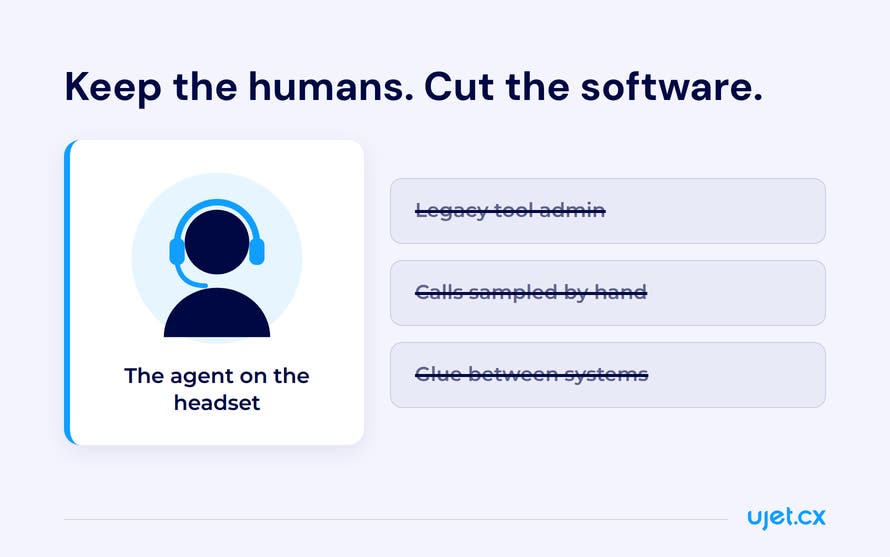
No. The agent on the headset stays and works in one desktop that already sees the customer. The roles that fade are the ones that existed to look after the stack, like legacy-tool administrators, the analysts who sampled calls by hand and whoever kept the systems talking to each other. UJET's position, stated plainly, is keep the humans and cut the software.
What happens to my CRM?
You won't need it after AXO, and it comes off the invoice when the contract does, on your clock. Nobody rips a CRM out on day one, but your team stops working inside Salesforce, ServiceNow, Zendesk or whatever you run today on day one, and the renewal is your call. The CRM became the place the customer record lived because there was no CDP or data lake when it was invented. That problem got solved, and your CDP or data lake is the unified profile now, which most teams are already writing their CRM data into, so the same record ends up living in two systems while only one of them sends you a renewal. AXO reads from that profile and writes to it, which makes it the CX platform built to run on your CDP.
Where does the customer data live?
No personally identifiable information is stored on UJET servers. AXO reads from and writes to the unified customer profile in your CDP or data lake, and every part of the platform works against that same profile.
Where does Spiral fit?
Spiral is the conversational analytics layer inside AXO. It reads 100% of customer conversations and turns them into decision-grade intelligence, which makes it the part of AXO that sees, while the agent desktop, virtual agents, Computer-Using Agents, quality and workforce management are the parts that act on what it saw. Spiral is also where most contact centers should start.
Where should a contact center start?
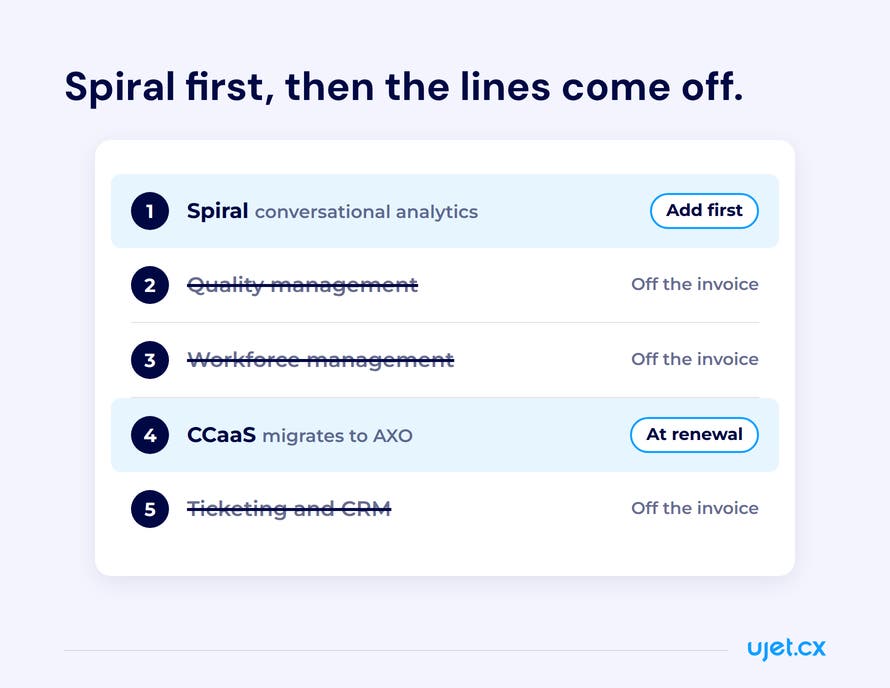
Start by adding Spiral, UJET's conversational analytics, because analytics is usually the weakest tooling in the building and everything after it runs on the conversation data Spiral reads. Once Spiral is in, quality management comes off the invoice first, and workforce management follows. When your CCaaS renewal is due, migrate to AXO to bring it all together. Ticketing and the CRM come last, once everything above them already works and the contracts come up, and nobody is asked to replace a whole stack in a quarter.
What is the "subtraction economy"?
The subtraction economy is the phrase UJET CEO Vasili Triant uses for what comes after fifteen years of adding tools to the contact center. The bet is that the next gains come from removing systems, because the cost problem was always the software sitting between the humans on the headset and the customer.
Where can I read more about AXO?
In short: Agentic Experience Orchestration (AXO) is UJET's end-to-end contact center platform where agentic AI acts across virtual agents, the agent desktop, analytics, quality and workforce management during the interaction, in self-service or with a live agent, and Computer-Using Agents carry out the work in back-office systems, even ones without an API, with a human in the loop. You won't need your CRM after it, and it comes off the invoice when the contract does. Start with Spiral.
The best customer experience content delivered right to your inbox.
About the authors