Stay updated!
The best customer experience content delivered right to your inbox.
The 95% Blind Spot: How Much Customer Conversation Data Goes Unanalyzed in Retail?


Your customers already told you why they're leaving. Nobody read it.
TL;DR: The typical contact center analyzes just 2–5% of its customer conversations — manual QA reviews less than 5% (McKinsey) and survey research puts the norm at 2–5% (Puzzel, n=1,505) — leaving roughly 95% unexamined. In retail, that unread 95% holds your churn warnings, your returns friction, and your holiday capacity plan. Conversational analytics closes the gap by analyzing 100%.
Every day, retail customers call, chat, and message your support team with the exact reasons they hesitated to buy, sent the jacket back, or almost left for a competitor.
Your agents hear all of it. They respond to it in real time. And then it disappears into a log nobody will ever open.
That is not a data problem. Retail brands are drowning in data. It is a visibility problem — the buying-behavior signals sitting inside your support conversations are structurally hidden from the people who could act on them.
So: how much customer conversation data goes unanalyzed? In a typical contact center, roughly 95%. Manual QA programs review less than 5% of conversations, and a 2026 survey of 1,505 CX professionals found the typical operation analyzes just 2–5% of interactions. Everything else is recorded, stored, and never looked at again.
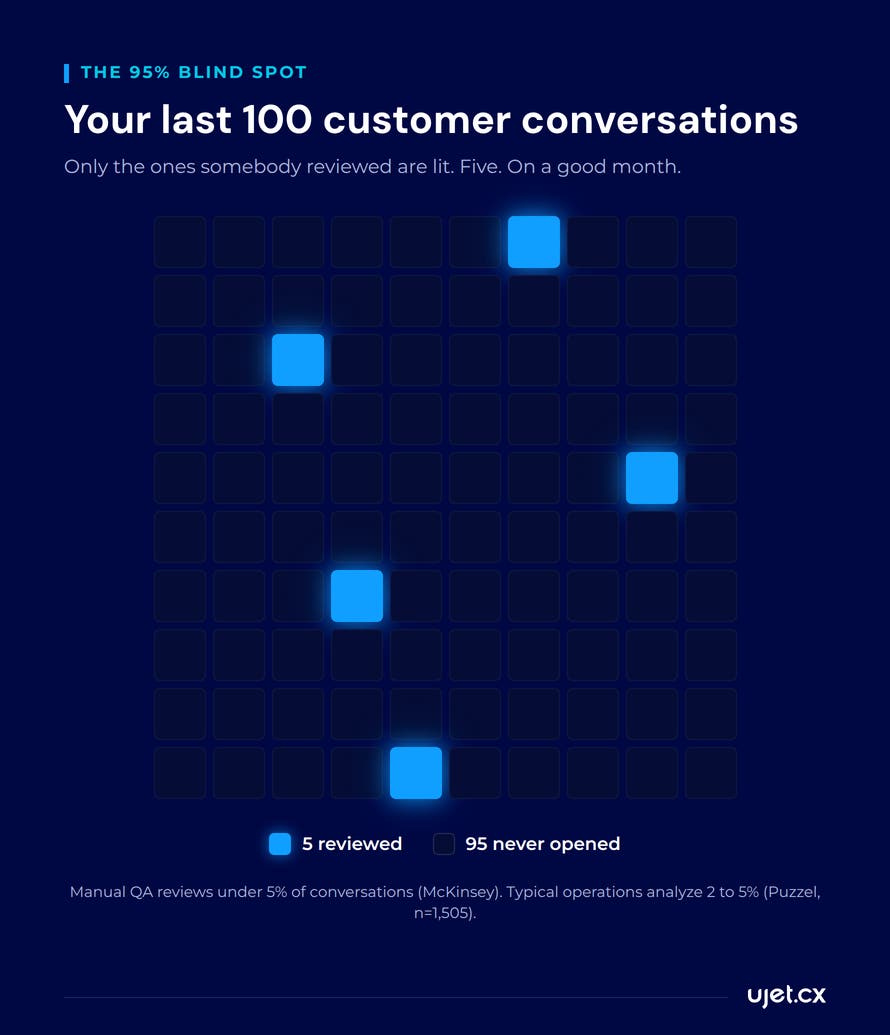
Picture your last hundred customer conversations as a ten-by-ten grid. Now light up the squares somebody at your company actually reviewed. Five squares. On a good month.
The other ninety-five sit dark. And in retail, dark is not the same as quiet. Those are the squares where customers explained, in their own words, why the checkout failed, why the return policy made them furious, and why they are not coming back.
What is actually hiding in the unread 95%
For a generic contact center, this is a QA problem. For a retail contact center, it is a revenue problem — because the things customers say to support are the things they will not say anywhere else.
Here is what sits in those unreviewed conversations in any given week:
-
Sizing and fit uncertainty that stalls a purchase or guarantees a return
-
Promotion friction — a code that will not apply, an offer nobody understands, a cart abandoned minutes after the chat ends
-
Delivery anxiety about arrival windows, which compounds fast in peak season
-
Stock confusion when the product page and the agent's screen disagree
-
Return drivers that expose product expectation gaps merchandising has never seen
-
Post-purchase regret — the language that predicts churn weeks before anyone formally cancels
Sampling might catch one of these as an anecdote. It cannot tell you that fit confusion is spiking on one specific SKU, or that promo-code failures doubled the day your campaign launched. That requires seeing all of it.
The blind spot is a choice dressed up as a constraint
Nobody decided to ignore 95% of customers. It happened because reviewing conversations meant humans listening to calls, and humans do not scale. So retail CX programs built two workarounds and called them a strategy: sampling and surveys.
The sampling problem
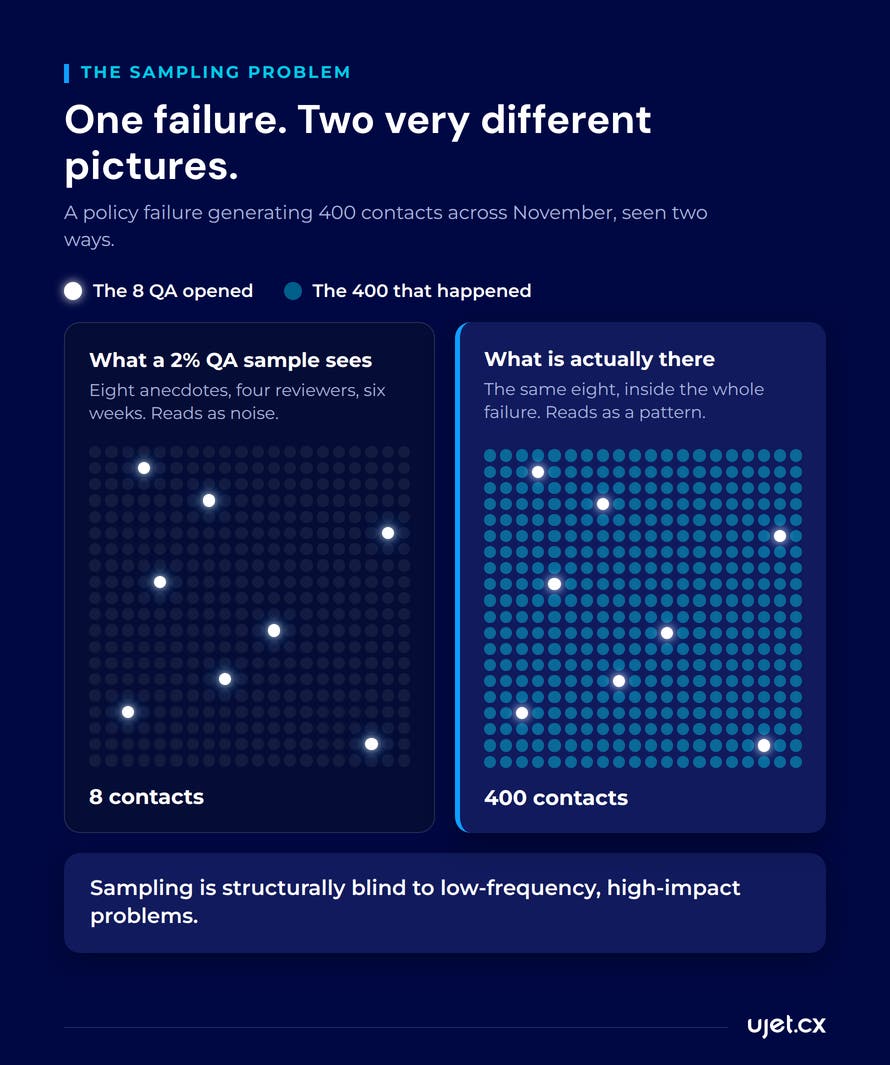
Sampling reviews 2-5% and extrapolates. The pattern you are hunting does not distribute itself politely across that sample. A policy failure generating 400 contacts across November shows up in a 2% sample as eight anecdotes, scattered across four reviewers and six weeks. That reads as noise, not signal.
The math is worse for the problems that matter most:
-
An issue affecting 1% of interactions (a mislabeled size chart, a broken tracking link on one carrier) surfaces roughly one instance per 3,300 conversations at a 3% review rate
-
Your QA team sees one. They miss the other thirty-two.
-
Those thirty-two quietly compound into a returns spike nobody predicted
Sampling is structurally blind to low-frequency, high-impact problems. Those are exactly the ones retail leaders need to catch early.
The survey problem
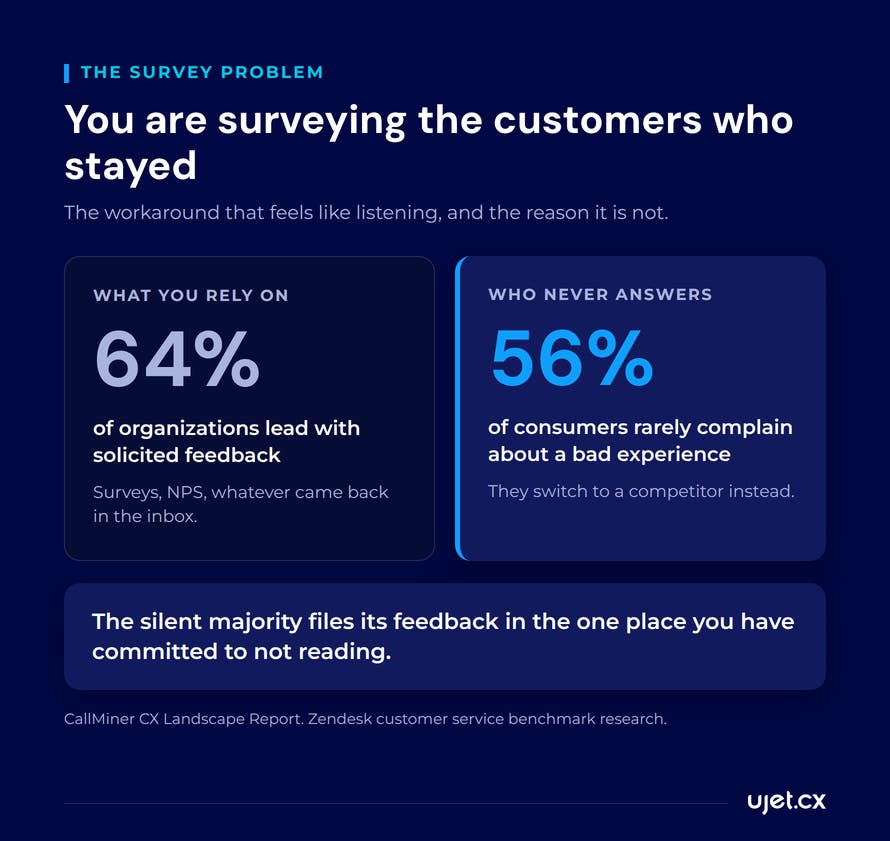
The survey workaround is quieter and worse. CallMiner's CX Landscape research found 64% of organizations still lean on solicited feedback as their primary customer data source.
The problem with asking instead of listening: the customers who matter most do not answer. Zendesk's benchmark research found 56% of consumers rarely complain about a bad experience. They switch to a competitor instead.
The silent majority skips your survey and files its feedback in the one place you have committed to not reading.
In retail, the unread 95% has a dollar value
Run the retail numbers through the blind spot and the stakes stop being abstract.
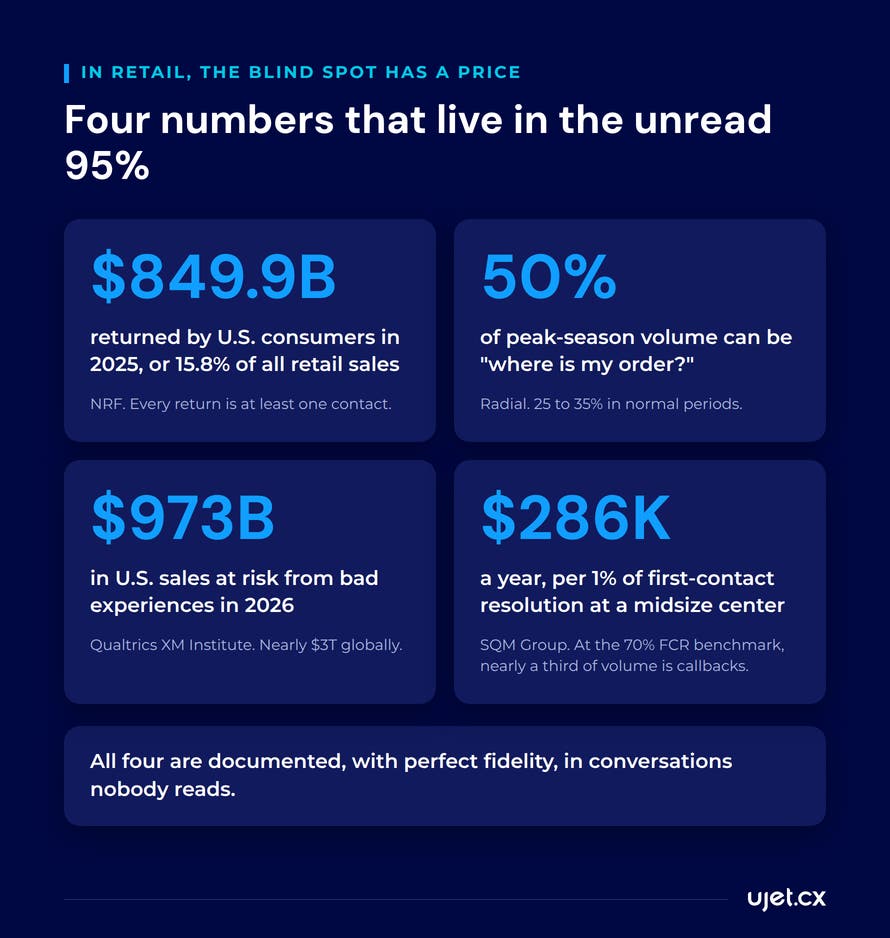
Churn decides fast, and silently. PwC's consumer research found 32% of customers will walk away from a brand they love after a single bad experience; Zendesk puts it at more than half after one and 73% after several. Qualtrics XM Institute sized the global exposure at nearly $3 trillion in sales at risk from bad experiences in 2026 — $973 billion in the U.S. alone. The warning signs for nearly all of it pass through a contact center first.
Returns are a conversation engine. U.S. consumers were expected to return $849.9 billion in merchandise in 2025 — 15.8% of all retail sales, with 17% of holiday sales coming back, per NRF. Every return is at least one potential contact. And the difference between a return that churns a customer and one that deepens loyalty is almost always something said out loud in that conversation — sitting, unread, in the 95%.
WISMO eats your queue. "Where is my order?" drives 25–35% of retail contact center interactions and spikes to 50% during peak. That is not demand. That is failure demand — contacts that exist only because tracking visibility, delivery expectations, or notification timing broke upstream. You cannot root-cause what you are sampling at 2%.
Repeat contacts are the tax on not knowing. SQM Group's benchmark research ties every 1% improvement in first-contact resolution to roughly 1% lower operating costs — about $286,000 a year for a midsize center — and notes that at the industry's 70% FCR benchmark, nearly a third of your volume is callbacks. The reasons those calls did not resolve the first time are documented, with perfect fidelity, in the conversations themselves.
What changes when you read all of it
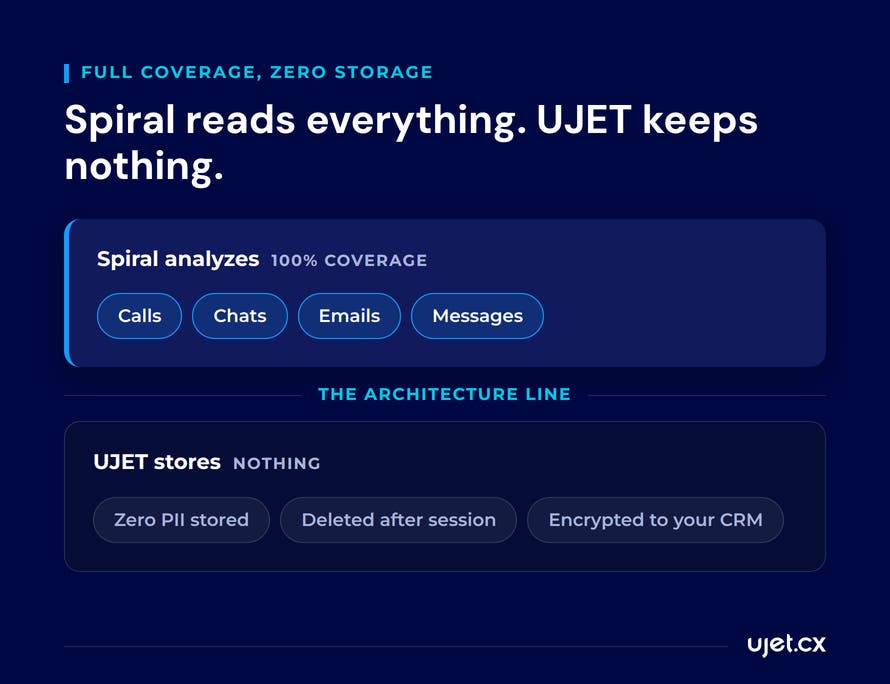
Spiral analyzes 100% of customer conversations — calls, chats, emails, messages — and turns them into structured, decision-grade intelligence. That is the job it was built for, and the gap it closes.
The output is not word clouds. It is contact drivers ranked by volume and trend. Policy failures caught the week they start generating contacts. Churn language flagged while the customer is still a customer. Agent coaching drawn from every conversation, not a lucky sample.
The 95-Grid, fully lit.
Full coverage requires zero storage
Full coverage is only responsible on an architecture that stores nothing. Analyzing every conversation on a platform that hoards transcripts and payment details builds a bigger honeypot, not a better product.
UJET's CRM-first model works differently. Customer communications are encrypted, transmitted to the retailer's own system of record, and deleted from the platform after the session. Zero PII stored. PCI-compliant payment handling via SmartActions. Spiral reads everything; UJET keeps nothing. That pairing is the answer to the first objection every enterprise buyer raises.
Conversational analytics is an operating layer, not a QA upgrade
Conversational analytics sits across your entire conversation set, regardless of channel. It turns fragmented voice, chat, email, and messaging data into a searchable source of customer truth.
Sampling tells you what happened in the conversations you reviewed. Conversational analytics tells you what is happening across all of them, right now.
One conversation set, three teams that have been flying blind
The real shift happens when this stops living inside the contact center.
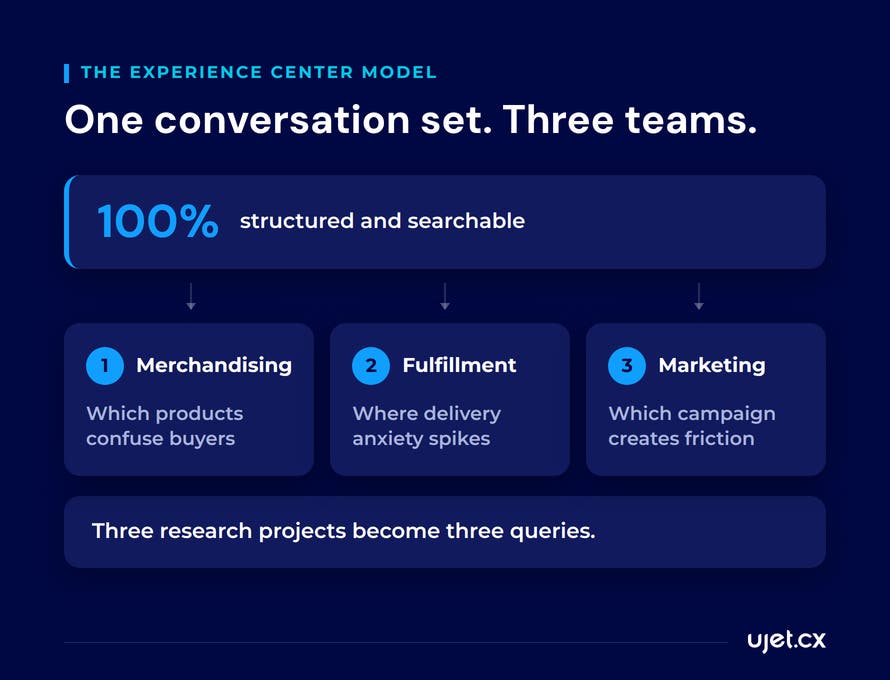
Merchandising needs to know which products generate disproportionate post-purchase confusion — because "the color looked different online" said four hundred times is a photography brief, not a service ticket.
Fulfillment needs to know when delivery anxiety is spiking by region, ideally before the carrier's own dashboard admits it.
Marketing needs to know when a campaign is generating friction instead of conversion — while the campaign is still running.
None of those teams have ever had access to this. They have had surveys, NPS verbatims, and whatever the CX director remembered to bring to the Monday meeting. When 100% of conversations become structured data, "what is driving contacts," "which regions have a service problem," and "what did customers actually say about the new return policy" stop being three research projects and become three queries.
That is what turns a contact center from a cost line into the richest voice-of-customer instrument a retailer owns. That is the Experience Center model.
The August argument: your holiday capacity plan is in last year's transcripts
There is a reason to do this now rather than in Q4.
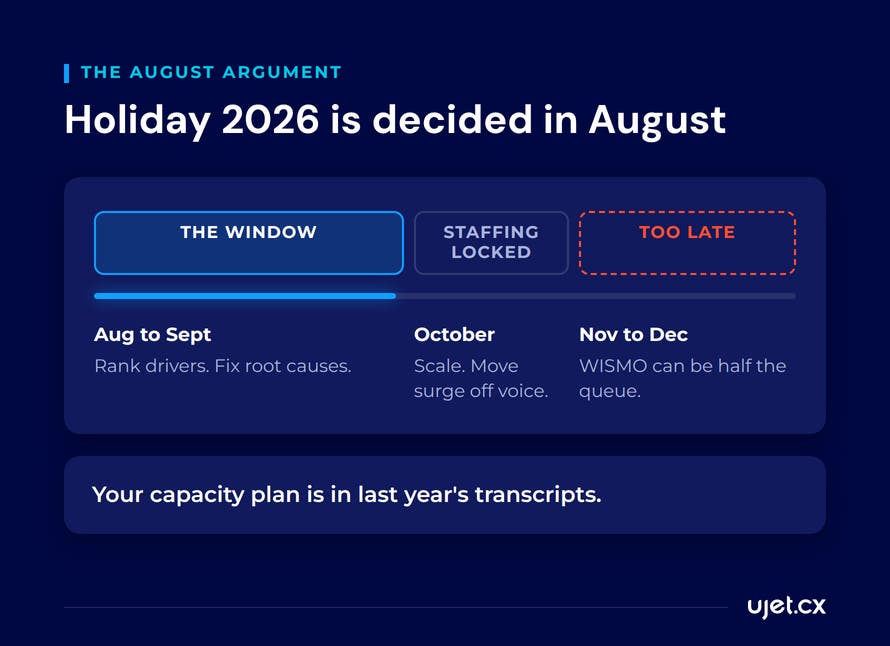
Holiday 2025 set another record — $257.8 billion in U.S. online spending, up 6.8%, per Adobe — plus one leading indicator worth staring at: traffic to retail sites from generative AI tools grew 693.4% year over year. Volume is rising, channels are multiplying, and peak compresses all of it into eight weeks where WISMO alone can be half your queue.
The retailers who hold service levels through holiday 2026 are baselining right now: which contact drivers dominated last peak, which policies generated failure demand, where FCR broke, what the silent switchers said on the way out. That analysis takes an afternoon with full-coverage data. It is impossible with a 2% sample.
And the window is still open. Deloitte's global contact center survey found only one in six contact centers has deployed GenAI capabilities — and that the leaders investing 2.7x more in analytics hit 57% more of their targets. The blind spot is still a competitive advantage for whoever closes it first.
UJET's AI runs in production, not in pilots. AXO — Agentic Experience Orchestration — becomes generally available at the end of September 2026, extending the same premise: intelligence during the interaction, inside governed guardrails, rather than analysis bolted on after the quarter closes. And retail brands are already running on the foundation that makes it possible: SPANX has had four years of operational stability on UJET, makes real-time IVR changes without filing a ticket, and personalizes hold experiences by customer region. As their VP of Global CX puts it: "UJET helps my team sleep at night, knowing we don't have to mitigate constant issues or downtime."
You cannot analyze conversations at scale if they are scattered across disconnected systems and logged inconsistently. Modern infrastructure is what makes conversational analytics possible. Conversational analytics is what makes the 95% visible.
Start by seeing what you are missing
The blind spot is structural. It is not a sign your team is not working hard enough. It is a sign the tools most retail contact centers run on were built for scoring interactions, not for surfacing buying-behavior patterns at scale.
You cannot optimize conversion, reduce returns, or protect loyalty using conversations you have never read. That is not a technology problem. It is a visibility problem, and visibility is fixable.
The retailers who close this gap first own a real competitive advantage: they know what customers almost bought, nearly returned, and said on their way out the door. Everyone else is guessing.
See what Spiral surfaces. Or start with a number: the UJET ROI estimator sizes the blind spot against your actual conversation volume.
FAQ
How much customer conversation data goes unanalyzed?
Roughly 95% in a typical contact center. McKinsey's operations research states that manual QA reviews less than 5% of customer care conversations, and Puzzel's State of Contact Centres 2026 survey (1,505 CX professionals) found the typical contact center analyzes just 2–5% of customer interactions. Note: the widely repeated claim that "95% of interaction data goes unanalyzed" per Gartner or Forrester has no verifiable source — the McKinsey and Puzzel figures are the citable versions.
What is conversational analytics?
Conversational analytics is AI that analyzes customer conversations — calls, chats, emails, messages — at full coverage and converts them into structured intelligence: contact drivers, sentiment, churn signals, compliance evidence, and agent performance insight. Spiral, UJET's conversational analytics AI, analyzes 100% of customer conversations and is built to produce decision-grade output rather than word clouds.
What buying-behavior signals show up in retail support conversations?
Six recur most often: sizing and fit uncertainty, promotion and promo-code friction, delivery anxiety, stock availability confusion between the product page and the agent, return drivers that reveal product expectation gaps, and post-purchase regret language that predicts churn. Individually they read as routine service inquiries. Analyzed at full coverage, they form a real-time map of purchase hesitation that ecommerce, merchandising, and marketing teams can act on.
What percentage of retail contact center volume is WISMO?
"Where is my order?" inquiries account for 25–35% of retail contact center interactions in normal periods and can reach 50% during holiday peak, per retail fulfillment provider Radial. WISMO is largely failure demand — driven by tracking visibility and notification gaps — making it one of the highest-ROI targets for both self-service automation and root-cause elimination.
How should retailers prepare their contact center for holiday peak?
Baseline before you staff. Analyze last peak's full conversation data to rank contact drivers, identify failure demand (WISMO, returns confusion, policy friction), and fix root causes between September and November. Then scale elastically — virtual agents for routine surge volume, channel blending to move traffic off voice, and consumption-based capacity. Retailers expected 17% of holiday sales to be returned (NRF 2025), so returns flows deserve first attention.
Does analyzing 100% of conversations create a privacy risk?
Only on the wrong architecture. UJET's CRM-first model stores zero customer PII on the platform — communications are encrypted, delivered to the retailer's own system of record, and deleted from UJET after the session, with PCI-compliant payment handling. Spiral's full-coverage analysis runs on that architecture, so complete insight does not require a second copy of sensitive data.
What is the ROI of full-coverage conversation analysis?
The most direct lever is first-contact resolution: SQM Group benchmarks tie each 1% FCR improvement to roughly 1% lower operating costs (~$286,000/year for a midsize center), and roughly 30% of volume at the 70% FCR benchmark is repeat contacts whose causes are visible in conversation data. Add reduced silent churn — 56% of consumers switch without complaining — and eliminated failure demand like WISMO.
The best customer experience content delivered right to your inbox.
About the authors