Stay updated!
The best customer experience content delivered right to your inbox.
Why AI in the Contact Center Still Does Not Pay Back


The CX AI ROI Problem Is Really an Orchestration Problem
Companies bought AI for the contact center all through 2025 and 2026, and most of them still can't show a return on it. The virtual agent, the copilot, the QA tool and the routing logic were each bought separately, each runs on its own data, and every handoff between them drops context somebody already paid to collect.
That is what Frost & Sullivan found in its 2026 analysis of the North American CX platforms market: organizations are consuming more AI than they expected, at a cost that keeps rising, for returns that have stayed limited, and some of the companies that reduced headcount are now hiring people back because the cost per contact for AI came out nearly level with an outsourced agent.
Adoption is close to universal at this point, so the problem is one of design, and it sits one layer below the conversation layer where most CX AI is currently being bought.
TL;DR: Enterprises spent 2025 and 2026 buying AI for the contact center, and the returns have been elusive because customer context lives in one system, the AI lives in another, the agent's workflow lives in a third, and the improvement loop lives in a quarterly consulting engagement, which means every individual piece can work while the journey as a whole does not.
The fix is orchestration, one layer that carries context across self-service, live assistance and continuous improvement. Frost & Sullivan's conclusion is that "the companies that win and lead with CCaaS in the future will be the ones that orchestrate." Everest Group reached a similar conclusion six months earlier, and Metrigy found data fragmentation to be the leading cause of AI project failure.
This piece covers the three ways bolt-on AI breaks, what orchestration changes, and the eight questions to ask a vendor before you sign.
What does the data actually say about CX AI returns in 2026?
Five independent findings, from four different firms, over an eighteen-month window.
|
Source |
Date |
Finding |
|---|---|---|
|
Frost & Sullivan |
Sept 2026 |
Organizations are consuming more AI than expected at rising cost with limited ROI. Some that reduced headcount are rehiring because AI cost per contact is nearly equal to an outsourced agent. |
|
Everest Group |
Sept 2026 |
"CX After the AI Hype Cycle": disconnected pilots, fragmented technology environments, and integration challenges are what keep AI in CX from reaching production scale. |
|
Metrigy, 759 companies across 10 countries |
May 2026 |
Data fragmentation is the number one cause of AI project failure. Companies that redesign work around AI see 25.9% better future cost reduction than those automating existing workflows. |
|
Everest Group |
April 2026 |
80% of organizations expect positive ROI from AI. 67% cite legacy infrastructure and 55% cite change management as the barriers to getting it. CCaaS growth has compressed to roughly 5% year over year from a 35% peak, and "convergence rewards orchestrators, not execution layers." |
|
CCW Digital market study |
2024 |
81% say AI's value is eliminated at 50% or less automation. 86% deal with customers who refuse to engage with bots. |
Read together, these describe a single condition in which expectations are high, the technology performs in isolation, and it underperforms once it is dropped into a real operation. Metrigy's finding is the sharpest of the five, because it puts the leading cause of failure somewhere most teams never look, in the fact that the data the AI needs is scattered across systems that were never designed to talk to each other, well away from model quality, prompt design or user resistance.
The ROI gap is an argument against fragmented AI investment, and only that. The same dollars, spent through one orchestrated layer instead of four disconnected tools, produce a different outcome.
Why does bolt-on AI fail in the contact center specifically?
Because a contact center is a relay, and bolt-on AI breaks the handoff.
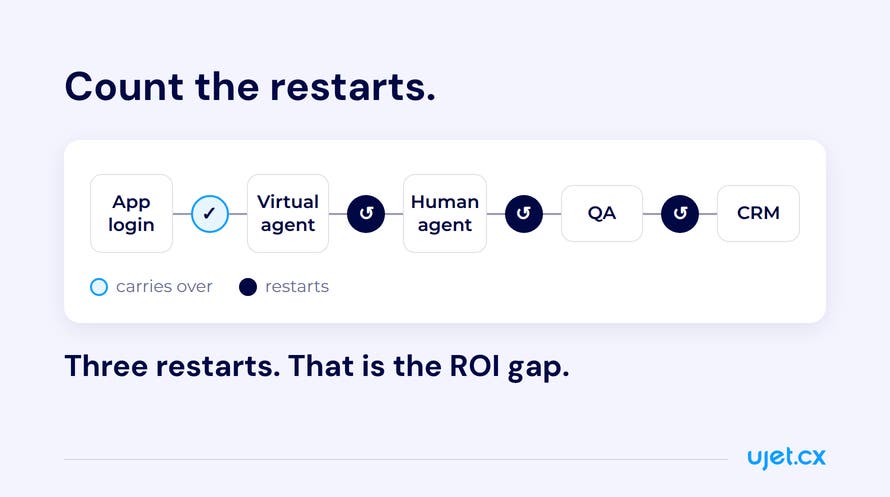
The sequence almost every enterprise deployment follows goes like this: a customer opens the app and authenticates, describes the problem to a virtual agent, the virtual agent gets partway and routes to a human, and the human picks up with none of the preceding context, asks the customer to authenticate again, and asks them to describe the problem from the beginning.
UJET's own survey of 250 frontline agents found that 65% of customers express frustration on every call about repeating information to an agent after a chatbot, that 81% of agents are working across more than four tools at once, and that 78% of them say their AI tools are not transformative.
The AI did what it was built to do and the system lost the thread anyway, which is why most AI ROI post-mortems look at the wrong layer. Model accuracy, training data and adoption all matter, but they are downstream of a failure that happens at the architecture level, in three specific places.
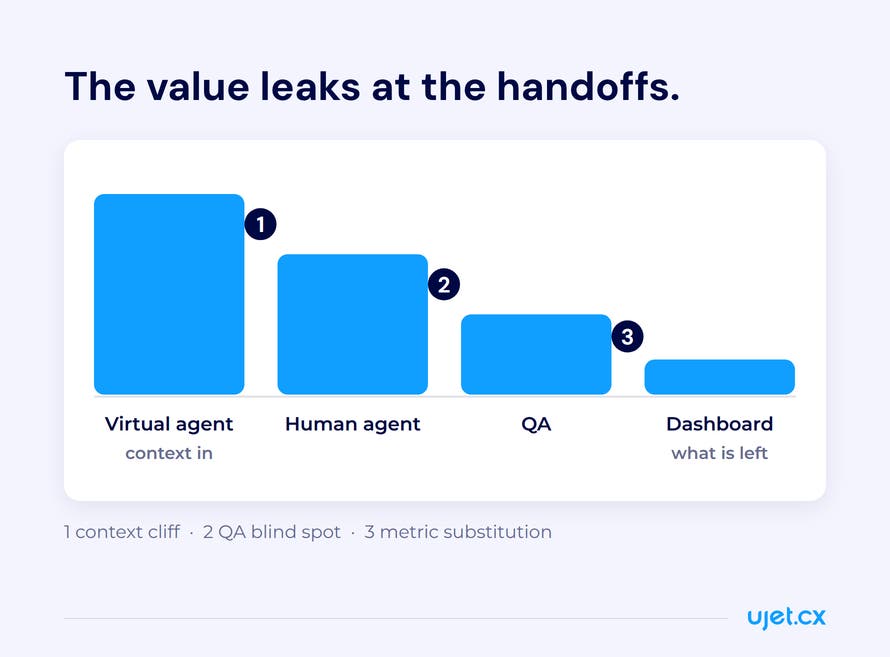
Failure mode 1: the context cliff
Authentication, intent, sentiment and history are captured by the automated layer and then either not passed to the human layer at all or passed as a transcript dump nobody has time to read, so the customer repeats themselves, the agent starts from scratch, and the "AI-assisted" interaction ends up costing more than a standard call because it took longer and consumed two resources instead of one. The virtual agent and the agent desktop were built on separate data models with no handoff protocol between them, and the bill for that arrives on every single escalation.
Failure mode 2: the QA blind spot
Traditional quality assurance reviews roughly 2% of calls, which leaves the other 98% of interactions, including every AI-handled one, invisible to quality oversight.
When AI is in a conversation that nobody ever reviews, nobody knows whether the AI improved the outcome or quietly degraded it, and a deployment can sit "live" for months generating bad outcomes that never surface in a dashboard. The insight that would have caught it arrives in a quarterly readout, turns into a tuning project, and lands as a change about six months after the pattern first appeared.
Failure mode 3: metric substitution
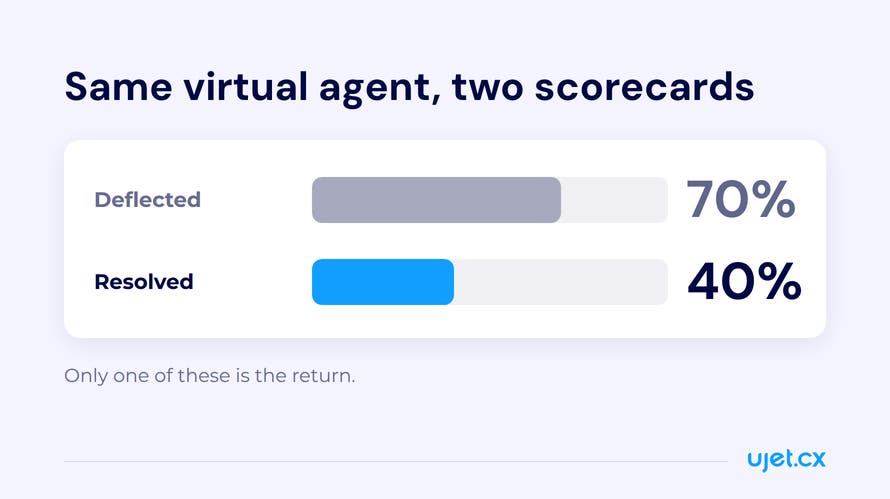
This one looks like success from the inside. A team deploys a virtual agent, measures deflection rate, watches it climb and reports the win, without measuring whether the deflected contacts were resolved, whether those customers came back through another channel, or whether CSAT on deflected interactions looks anything like CSAT on resolved ones.
Deflection is not resolution. Measuring the wrong metric does worse than hide the problem, it delays the fix, because leadership believes the investment is already working.
The pattern across all three failure modes: they share one root, which is that there is no context layer connecting the AI components, so each component optimizes for its own local number and the system as a whole underperforms. The models were never the problem.
What does orchestration actually change?
Orchestration means one layer holds the context, the decisions and the improvement loop across the whole journey, so every stage reads from the same copy. In practice it changes four things.
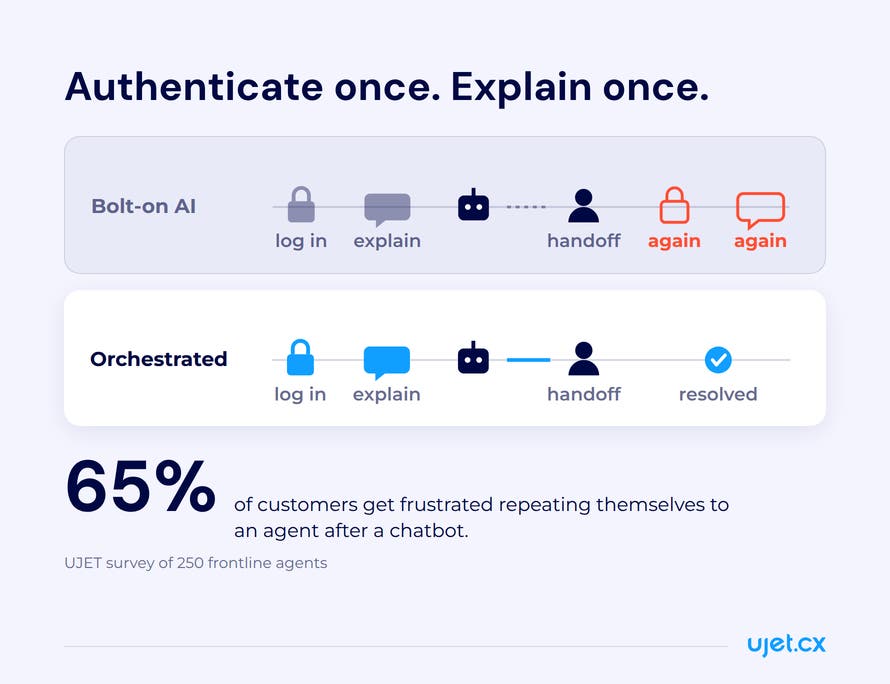
Identity is established once. On a mobile-native platform, biometric authentication resolves who the customer is at the moment they open the app, and Frost & Sullivan's assessment of that approach is that mobile-native architecture and biometric authentication "establish a new standard for frictionless customer engagement, by eliminating redundant authentication cycles and enabling pre-session context sharing." There is no re-authentication at the handoff because there is no second authentication event left to perform.
Context travels with the customer. Pre-session actions let the customer verify identity and choose their interaction mode before an agent connects, so everything gathered before the handoff is still present after it, and a customer who started on mobile, continued in chat and then called in is treated as one person with one issue instead of three separate contacts.
The channel adapts to the problem. An agent can request a photo, a screenshot or a video where a spoken description would take five minutes and still be wrong, which matters disproportionately in insurance claims and telecom troubleshooting.
Improvement runs continuously. A conversational analytics engine that ingests every interaction identifies what is breaking, surfaces the root cause and feeds that back into how the automation behaves, which is the difference between an AI that gets tuned once a year by consultants and one that adjusts as the pattern emerges.
Why does the underlying platform architecture decide whether AI works?
Because AI inherits the reliability, the data quality and the deployment speed of whatever it is running on, and the least glamorous specifications turn out to be the ones that determine outcomes.
-
Deployment time. Peer review sites report an average CCaaS deployment time of two months for UJET, against multi-quarter timelines for more complex platform migrations, and a shorter deployment means the AI is producing data sooner.
-
Release cadence. Weekly updates, covering both features and fixes.
-
Data handling. A privacy-by-design architecture that stores no personally identifiable information on the platform, which materially reduces compliance overhead for regulated industries.
-
Resilience. Triple redundancy at the telephony layer, projects running across three zones inside a Google Cloud region, and a multi-region active-standby configuration for geo-redundant failover.
-
Retrieval scope. Knowledge assist and next-best-action built on retrieval-augmented generation against the enterprise's own knowledge base, because an assistant retrieving from public knowledge answers the question the internet would answer, and when your return window is 30 days and the model says 14, the customer finds out at the counter.
-
System of record. A CRM-first design, so that what the virtual agent did, what the agent said and how the interaction ended are written back to the record in real time, with no nightly batch and no manual sync.
-
Reporting latency. Dashboard refresh in under one minute, so what you are looking at is what is happening now.
Frost & Sullivan's evaluation treats these as a single proposition: they "collectively reduce operational risk and represent a strong price-to-performance proposition relative to more complex alternatives in the market."
What is Agentic Experience Orchestration (AXO)?
Agentic Experience Orchestration (AXO) is a layer that delivers agentic AI at every touchpoint of the customer journey, from build and deployment through self-service, live assistance and continuous improvement, and it overlays an existing CCaaS platform rather than replacing it.
The operating principle is a two-way loop, with humans in the loop to get the most out of the AI and the AI in the loop to get the most out of the humans. The conversational analytics engine continuously ingests interaction data, identifies optimization opportunities and surfaces recommendations that adapt virtual agent behavior over time, and that closed loop reduces the need for consulting-led tuning engagements, which is where most AI improvement budget currently goes.
AXO is the layer UJET is bringing to market this fall.
Can you get value without replacing your CCaaS platform?
Yes, and for most enterprises this is the only realistic path, because rip-and-replace cycles remain long.
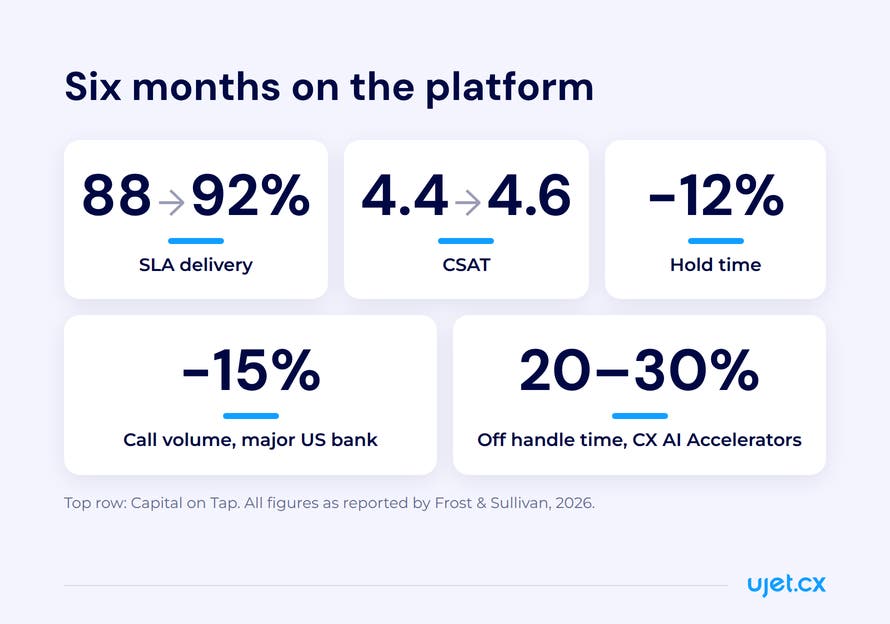
CX AI Accelerators are standalone capabilities, including Virtual Agent, Agent Assist, conversational analytics and screen sharing, that deploy over the top of an existing CCaaS platform, and Frost & Sullivan reports that customers running them are already shaving 20–30% off average handle time by reducing wrap time, so an agent reaches the next interaction sooner and wait times come down as a result.
The sequencing matters more than the technology does. Layer capability onto what already exists, generate measurable value in the current quarter, and let the evidence arrive before the platform decision has to be made.
What proof exists that this produces measurable outcomes?
| Organization | Result |
|---|---|
| Capital on Tap | SLA delivery 88% to 92%. Average hold time down 12%. CSAT 4.4 to 4.6 with 92% overall satisfaction. 90% of calls answered in 15 seconds or less. Achieved in six months, and "without the need for an over engineered system." |
| Major US bank | 15% reduction in call volume. 50% increase in agent digital chat interactions. 10% decrease in contact center operating costs, after replacing multiple legacy on-premises systems. |
| Turo | Product team became the primary consumer of conversational analytics, accessing customer insight without contact center intermediation. |
| CX AI Accelerator customers | 20–30% reduction in average handle time through wrap-time compression. |
All four rows are as reported in Frost & Sullivan's 2026 analysis, and the Capital on Tap detail worth isolating is that the gains came from removing steps.
What should buyers ask when evaluating an AI-first CX platform?
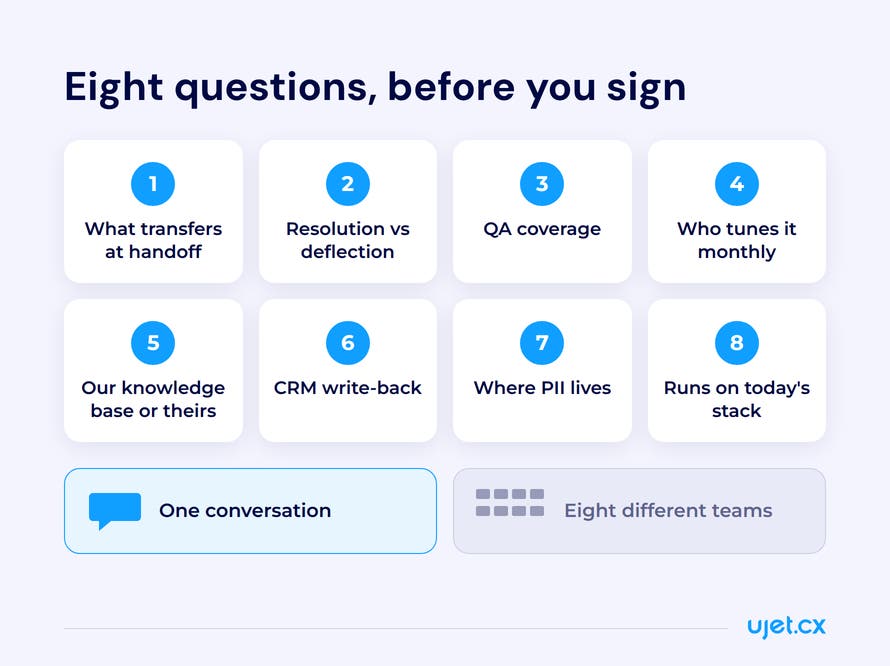
Vendor demos are optimized to show you what works, and these eight questions are designed to surface what does not.
-
When automation hands off to a human, what exactly transfers, and does the customer authenticate again? Ask to watch it happen rather than read about it, because if the answer is "the agent sees a summary" or "there is a handoff note," the context cliff is already in your contract.
-
How do you define and report resolution separately from deflection? Deflection means the customer did not reach a human and resolution means the issue was actually solved, and a vendor who cannot show you both numbers side by side is measuring the wrong one.
-
What percentage of interactions does your quality process actually review? If it is anything less than 100%, ask how AI-handled interactions get into the sample, because if they do not, you have no quality signal at all on the component you just bought.
-
How does insight from last month's conversations change how the automation behaves this month, and who performs that change? If the answer is a services engagement, the loop is manual.
-
What does your assistant retrieve from, our knowledge base or a general model?
-
How does AI action write back to our CRM? Real time and bi-directional, or a nightly batch plus a separate integration project, and the second answer means your system of record will always be behind your AI layer.
-
Where does personally identifiable information live, and for how long?
-
What can we run on top of our current platform to produce value before any migration decision, and what is your true average deployment time? Ask for three references who will confirm the number.
A vendor with an orchestration story answers all eight in the same conversation, and a vendor with a feature story answers them from eight different teams.
Frequently asked questions
Why is AI not delivering ROI in the contact center?
Because AI is generally deployed on top of fragmented systems instead of orchestrated across them. Frost & Sullivan's 2026 analysis found rising AI consumption and cost with limited returns, and Metrigy identified data fragmentation as the leading cause of AI project failure. The models perform as designed, and the handoffs between systems lose the context that would have made the output useful.
What does orchestration mean in CCaaS?
Orchestration means a single layer carries customer context, AI decisions, agent workflows and improvement feedback across the full journey, so every stage operates on the same information. Frost & Sullivan's 2026 conclusion is that the companies leading the next era of CCaaS will be the ones that orchestrate.
What is Agentic Experience Orchestration?
Agentic Experience Orchestration (AXO) is UJET's platform layer delivering agentic AI at every journey touchpoint, from build through self-service, live assistance and continuous improvement. It overlays an existing CCaaS platform and operates a closed loop in which AI improves human performance and human feedback improves AI behavior.
What is the difference between deflection rate and resolution rate?
Deflection rate measures how many customers did not reach a human agent, while resolution rate measures how many customers had their issue solved. A virtual agent that deflects 70% of contacts but resolves only 40% of issues is reporting a misleading success metric, because resolution is the outcome measure that matters for ROI and deflection is an activity measure that can hide underperformance.
Can we modernize CX without replacing our contact center platform?
Yes. CX AI Accelerators, including Virtual Agent, Agent Assist, conversational analytics and screen sharing, deploy over the top of an existing CCaaS platform, so value arrives before any platform migration decision has to be made.
How much of customer conversation does quality assurance normally review?
Traditional QA processes review approximately 2% of calls. Conversational analytics platforms analyze the full volume, which is what allows root-cause insight instead of category counting and what makes AI-handled interactions visible to quality oversight at all.
What is the Frost & Sullivan 2026 Competitive Strategy Leadership Recognition?
Frost & Sullivan's Competitive Strategy Leadership Recognition identifies the company with a standout approach to top-line growth and superior customer experience. It follows a twelve-month analytical process evaluating nominees across ten criteria in two dimensions, Strategy Innovation and Customer Impact. UJET received Frost & Sullivan's 2026 North America Competitive Strategy Leadership Recognition in the customer experience platforms industry.
The architecture decision is the ROI decision
The research is consistent across Frost & Sullivan, Metrigy, Everest Group and CCW: the organizations achieving measurable CX AI ROI are the ones whose AI tools share a common context layer, report on outcomes, and hand off with full information, regardless of how many tools they own, and every dollar spent on a point tool that does not connect to the rest of the stack buys a local metric and a system-wide leak.
The diagnostic to take back to your team: draw a map of every AI component in your contact center today, and at each handoff between components, ask whether customer context transfers automatically or restarts. The number of restarts is your ROI gap.
Read the Frost & Sullivan report, or skip the reading and click through the product yourself, from virtual agent to human handoff to QA, with no sales call required.
The best customer experience content delivered right to your inbox.
About the authors