Stay updated!
The best customer experience content delivered right to your inbox.
How to Get Contact Center Modernization Approved in 2026: The CX Leader's Playbook


You already have the wins... so why do you keep losing the room?
Getting contact center modernization approved in 2026 is a truly a translation problem: convert your operational results into cost, risk, and revenue, win the four people on the buying committee, time the ask to the budget cycle, and answer the objections before they are spoken.
The short answer: Finance does not approve "modernization." It approves cost reduction, risk mitigation, and revenue enablement. Translate every metric you bring into one of those three before you walk in.
You see the impact every day: handle time, first-contact resolution, service level, CSAT. You know that when those numbers move, retention and reputation move with them. Then the proposal reaches leadership, lands in a room that runs on cost, risk, and revenue, and stalls. That is a failure of translation, and translation is a learnable skill. The category you are selling has a name, the Experience Center: a contact center run as a revenue engine instead of a cost line.
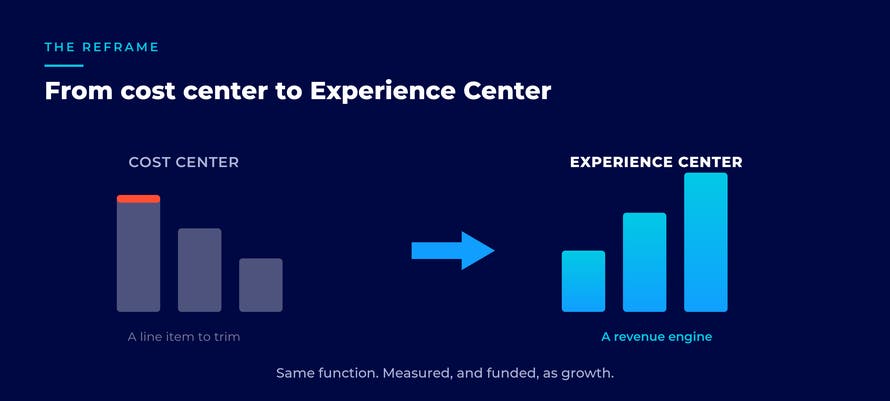
Here is how to make it land in a room of budget holders.
So, who is in the budget room?
The budget meeting is rarely one person saying yes. It is a small committee, and each member is weighing a different risk. Win all four like this:
| Stakeholder | What they are weighing | What wins them |
|---|---|---|
| CFO | A return they can defend: payback period, an ROI band, a baseline that will not drift | The cost-risk-revenue translation, anchored in real operational data |
| IT / CIO | What this does to the stack and the security posture | A platform built natively on Google Cloud, CRM-first, with no customer PII stored on the vendor's servers |
| COO | Operational continuity, no service cliff during migration | A phased cutover with a concrete adoption plan |
| Procurement | Predictable, transparent pricing with no surprises | Marketplace-based pricing purchased against an existing cloud commitment |
Map your case to these four before the meeting. The fastest way to lose is to bring a CX argument to a room where three of the four people are weighing something else entirely. Architecture does quiet work here: buying through the Google Cloud Marketplace against an existing cloud commitment answers IT and Procurement in the same breath, before either objection is raised.
Translate your wins into what leadership funds
Modernization gets approved when it improves at least one of three things leadership already tracks: cost to serve, risk and resilience, or revenue impact. Take your three strongest operational results and write the financial translation next to each before you walk in.
| Operational metric | Financial translation |
|---|---|
| Handle time down as after-call work is automated | Recovered agent hours: volume × AHT reduction × fully-loaded hourly cost |
| Repeat contacts down as resolution quality rises | Avoided repeat-contact cost: repeat-rate reduction × cost per contact |
| Volume shifted to self-service and digital channels | Lower cost per resolution and eased staffing pressure |
| Service level up, abandonment down | Retained revenue on at-risk accounts |
| Agent turnover down as ramp time shrinks | Avoided recruiting and ramp spend per seat |
The translation is your job, not theirs. Leadership should never have to do the conversion in their heads while you are talking. Doing it for them is what separates an approved case from a filed one.
Time the ask before the numbers lock
A strong case at the wrong moment loses. Two rules govern timing.
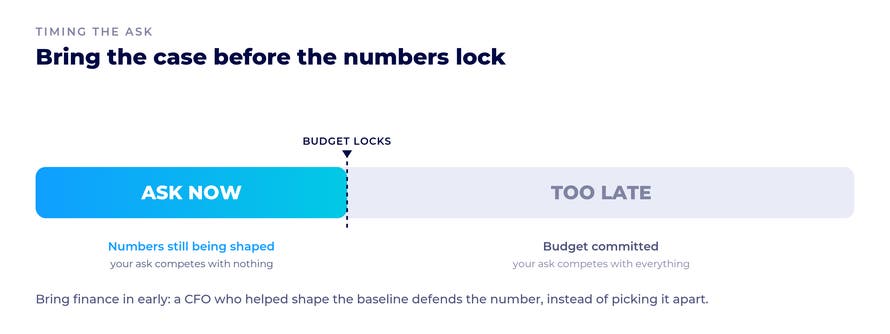
- Get ahead of the budget cycle. Bring the case while next year's numbers are still being shaped, before they lock. An ask that arrives mid-cycle competes with everything already committed and nothing still open. The leaders who move early are the ones who get funded.
- Bring finance in before the formal meeting. Share the framing and the draft model early and let the CFO pressure-test it. A CFO who helped shape the baseline defends the number in the room instead of picking it apart. Early involvement turns your toughest reviewer into a co-author.
Build the one-page business case leadership will actually read
Leadership scans a page; they do not read a deck. Structure it so a busy CFO gets the whole argument in ninety seconds.
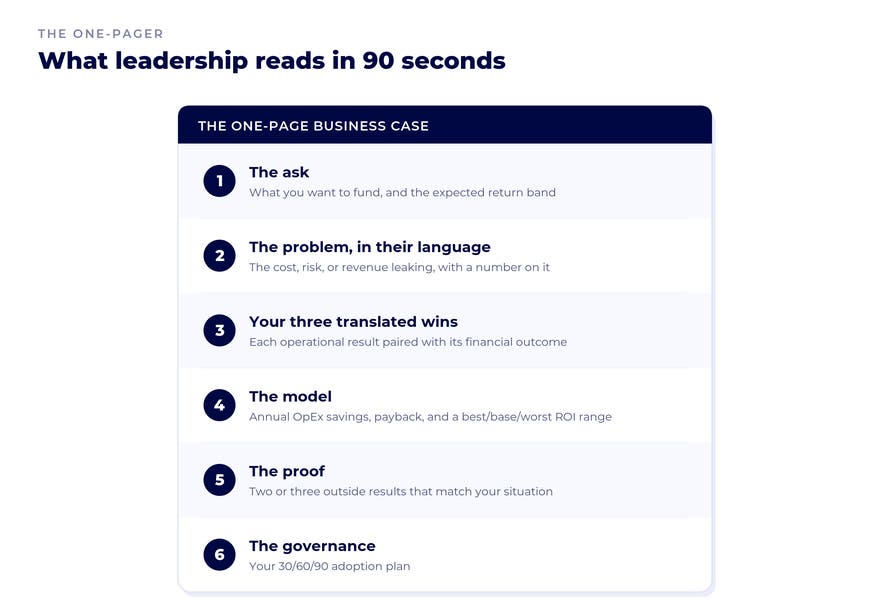
- The ask: one line, what you want to fund and the expected return band.
- The problem in their language: the cost, risk, or revenue currently leaking, with a number on it.
- Your three translated wins: operational result to financial outcome, one line each.
- The model: annual OpEx savings, payback period, and an ROI range across best, base, and worst cases. Not a single heroic number.
- The proof: two or three outside results that match your situation.
- The governance: your 30/60/90 adoption plan.
Line 4 is where most champions guess, and it is the part finance trusts least. Every line of the case should map to a measurable outcome. You do not have to guess: book a meeting and a UJET sales engineer builds the defensible version with you on your real baseline. (A self-serve ROI estimator for a first-pass figure lands in August!)
Script the three objections before they are spoken
The same three objections come up in almost every finance review. Walk in with the answers built.
"I don't trust operational metrics." Agree, on their own they should not. Tie each metric to a financial outcome with fixed before-and-after measurement windows and a set reporting cadence so the baseline cannot drift. When they push on the baseline itself, this is the line that holds: it is built on 100% of conversations, not a 2% QA sample. That is the job Spiral does, so the starting number survives scrutiny.
"What about hidden costs?" Put the full total cost of ownership on the table first: implementation, telecom, analytics, QA and workforce-management add-ons, integration maintenance, IT overhead. Then note that pricing is transparent and marketplace-based, so there are no usage surprises to forecast around. A CRM-first platform with no customer PII stored on the vendor's servers also takes a class of compliance and breach exposure off the risk register. Raising all of this before they do signals rigor and buys trust for the rest of the ask.
"What if adoption is low?" Adoption is the risk most in your control. Show the 30/60/90. This turns their sharpest objection into proof that you have already thought like them.
The 30/60/90 that turns approval into credibility
Adoption is where CX leaders win or lose credibility after the yes. Bring a plan leadership can hold you to.
| Milestone | What happens |
|---|---|
| Day 30 | Baseline captured, KPIs defined (AI-assist share, self-service shift, integrated-workflow adoption), measurement cadence set |
| Day 60 | First executive checkpoint, early movement reported against baseline, adoption blockers surfaced and addressed |
| Day 90 | Value realization tracked on a formal reporting schedule, accountability structure confirmed for the next review |
Attach executive checkpoints to each milestone. That is what turns a one-time approval into a track record for your next ask, and it is what separates a modernization program from a modernization project.
Proof to bring into the room
Pick the two or three closest to your environment and drop them into the case as evidence.
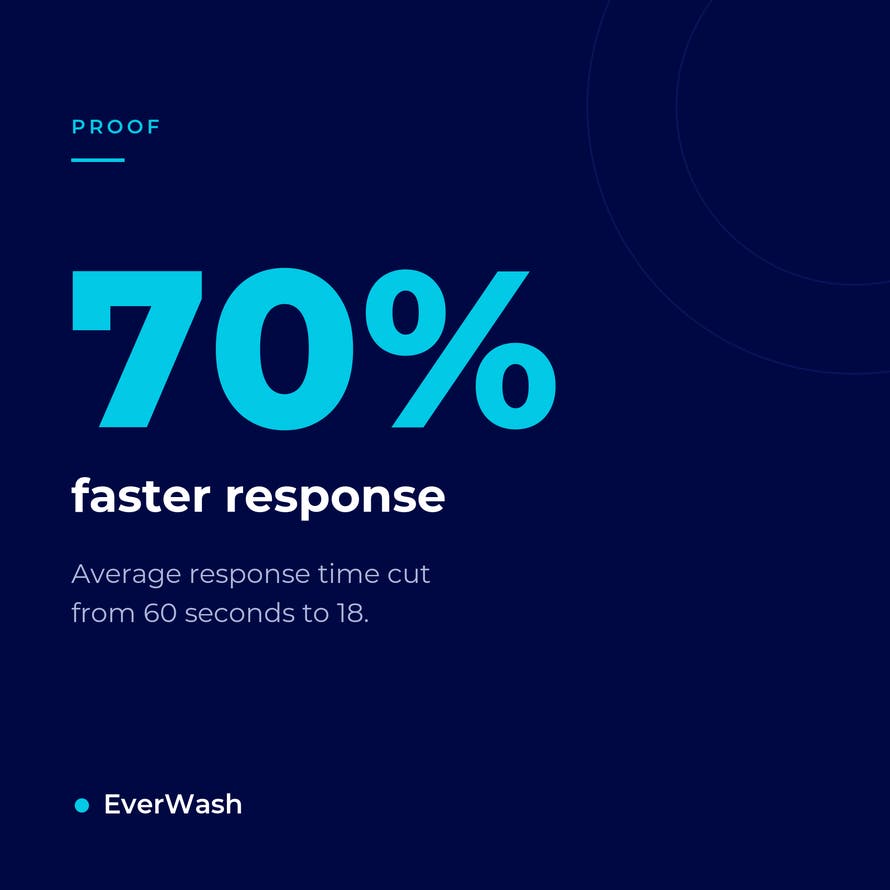
- EverWash cut average response time by 70%, from more than 60 seconds to 18. Model the freed capacity as deflected headcount or as volume growth absorbed without additional hiring.
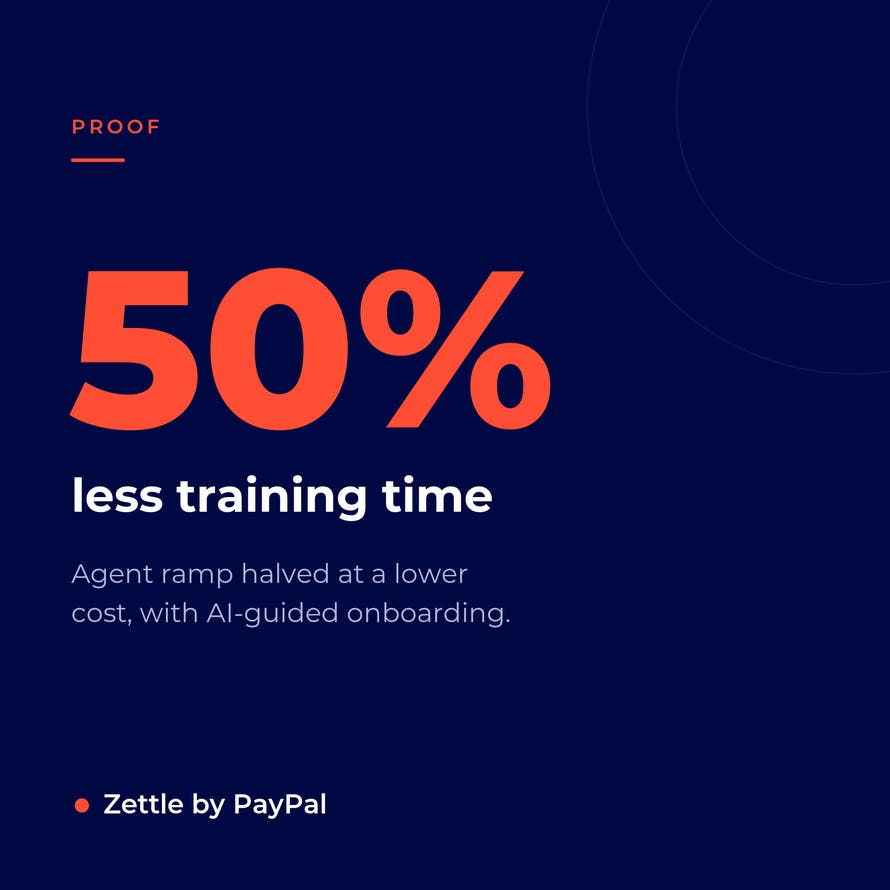
- Zettle by PayPal adopted AI-guided onboarding, raised CSAT 10%, and halved agent training time at a lower cost than its previous solution. Cutting ramp time in half reduces onboarding cost with the very next agent cohort, a number procurement and the COO both feel immediately.
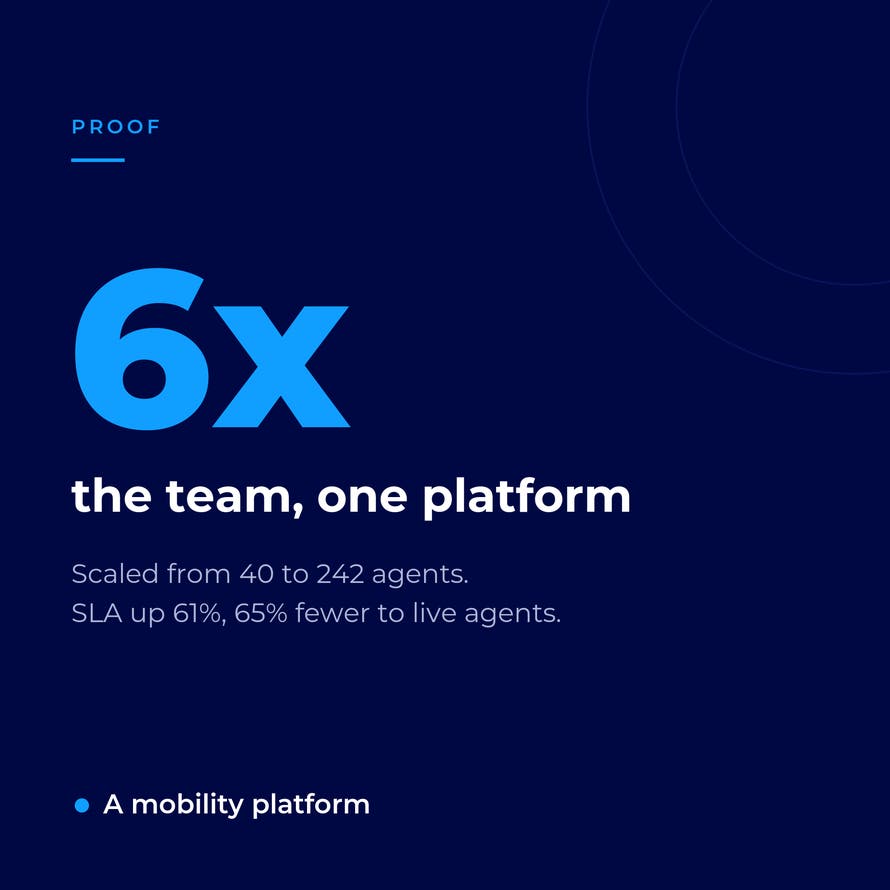
- A mobility platform improved SLA by 61% over three years while scaling from 40 to 242 agents and routing 65% fewer calls to live agents. That is the cost-center-to-growth-driver thesis in one line: six times the team, absorbing far more than six times the demand, without a linear rise in cost to serve.
Use only the analogs that match your industry, your scale, or your dominant pain. One precise proof point lands harder than three generic ones.
Make the case with us
This playbook gives you the room, the committee, the timing, the scripts, and the proof. The one thing that turns all of it into a yes is a number built on your real operation.
Book a meeting and a UJET sales engineer builds the defensible model with you on your real baseline.
(For a first-pass figure, the self-serve ROI estimator is live at https://ujet.cx/resources/tools/roi)
For the finance-side companion to this playbook, read The CFO's Guide to Contact Center ROI in 2026.
FAQ
How do you get budget approved for contact center modernization?
Translate your operational wins into the three outcomes leadership funds (cost to serve, risk and resilience, revenue impact), win the full buying committee rather than just the CFO, time the ask to the budget cycle before numbers lock, and script the three standard objections in advance. Bring a one-page business case anchored by an ROI model built on your real baseline.
Who needs to approve a new contact center platform purchase?
Usually a committee of four: the CFO (defensible return), IT or the CIO (stack impact and security posture), the COO (operational continuity during migration), and Procurement (predictable, transparent pricing). Each weighs a different risk, so a case built only for the CFO stalls on the other three.
When is the best time to propose a contact center upgrade?
While next year's budget is still being shaped, before the numbers lock. An ask that arrives mid-cycle competes with everything already committed. Bring finance in early to pressure-test the model so your toughest reviewer becomes a co-author who defends the number in the room.
How do you answer a CFO who does not trust CX metrics?
Tie every operational metric to a financial outcome with fixed before-and-after measurement windows and a set reporting cadence so the baseline cannot drift. If they challenge the baseline itself, show that it is built on 100% of conversations rather than a 2% QA sample, the job Spiral does, so the starting number holds up under review.
What should a contact center business case include?
Six things on one page: the ask and expected return band, the problem in cost/risk/revenue terms with a number, your three translated wins, the ROI model (annual OpEx savings, payback, and a best/base/worst range), two or three matching customer proofs, and a 30/60/90 adoption plan that governs the rollout.
P.S. Both playbooks are now full eBooks if you're ready for an even deeper dive:
From Cost Center to Growth Driver and The CFO's Guide to Contact Center ROI
The best customer experience content delivered right to your inbox.
About the authors