Stay updated!
The best customer experience content delivered right to your inbox.
Compliance-First Contact Centers: How Fintech and Banking Teams Handle AI Without the Risk

Why regulated contact centers need controllable AI, not just capable AI
TL;DR: Compliant contact center AI requires three architectural conditions: PII stays in the CRM, AI discloses itself by design, and 100% of interactions are retained as auditable evidence. Platforms that cannot meet all three are a governance liability, regardless of their AI capability.
Fintech and banking contact centers deploy AI compliantly by fixing the architecture first. Customer PII stays in the CRM. AI discloses itself and operates inside governed guardrails. Every conversation is retained as auditable evidence. Get those three right and AI stops being a regulatory exposure. Get them wrong and no amount of policy documentation saves you.
Here is the uncomfortable part: most financial services teams have the order backwards. They write the AI policy, form the governance committee, run the vendor risk assessment, and then bolt the AI onto a contact center platform that stores customer data it was never designed to protect. The paperwork is immaculate. The architecture is the liability.
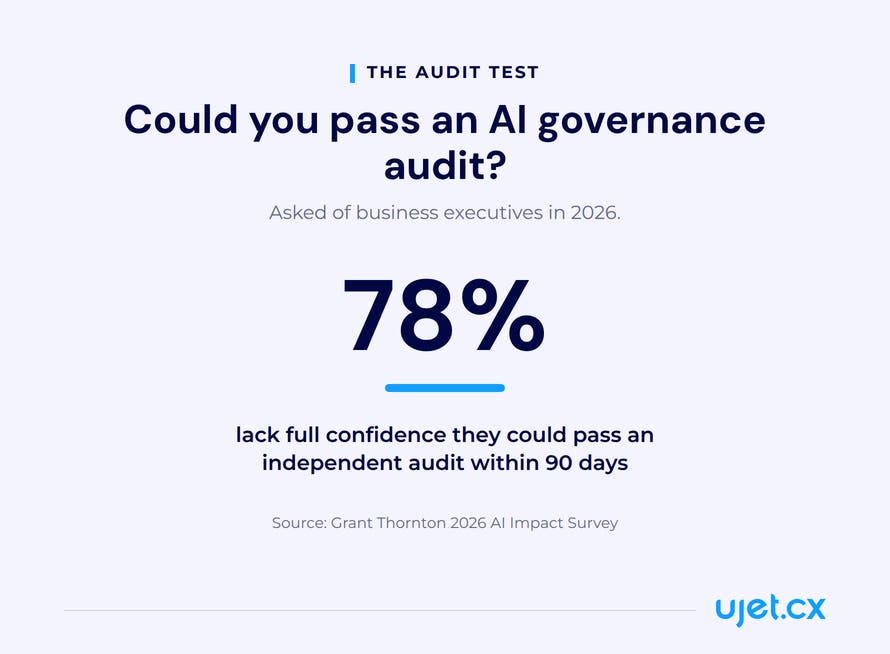
Try this test: if a regulator asked why your contact center AI gave a customer a particular answer last Tuesday, could you produce the record? According to Grant Thornton's 2026 AI Impact Survey, 78% of executives lack full confidence that their organization could pass an independent AI governance audit within 90 days. That is not a technology gap. It is an architecture gap, and the contact center is where it surfaces first.
Why compliance teams are right to be nervous about contact center AI
Because the regulators told them to be, in writing, with dates attached.
EU AI Act: transparency requirements
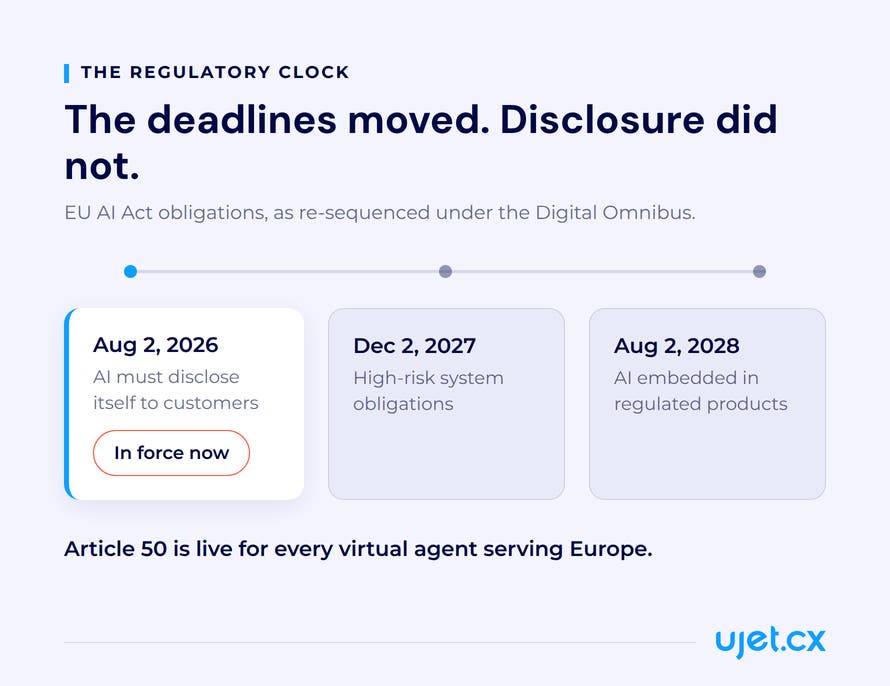
On August 2, 2026, the EU AI Act's Article 50 transparency obligations went live. Customers interacting with an AI system must be told they are interacting with an AI system. The heavier high-risk obligations were postponed to December 2, 2027 and August 2, 2028 under the EU's Digital Omnibus agreement, but the disclosure requirement held its original date. If your virtual agent is talking to customers in Europe today and not identifying itself, you are not early to a trend. You are late to a law.
U.S. regulatory landscape: CFPB, ECOA, and NIST
The U.S. pressure is older and more specific to banking. The CFPB's June 2023 Issue Spotlight on chatbots in consumer finance flagged exactly the failure modes compliance officers lose sleep over:
-
Chatbots giving inaccurate information about financial products
-
Dead-end loops that block a customer's legal right to dispute a charge
-
Customer data flowing into systems nobody vetted
In credit contexts, ECOA adverse-action duties attach to the decision, which means AI cannot be treated as a black box when lending or account decisions are involved. The NIST AI Risk Management Framework names content provenance, pre-deployment testing, human oversight, and incident disclosure as core risk controls.
Operationally, your contact center AI needs to be explainable, logged, and overridable. Not eventually. Now.
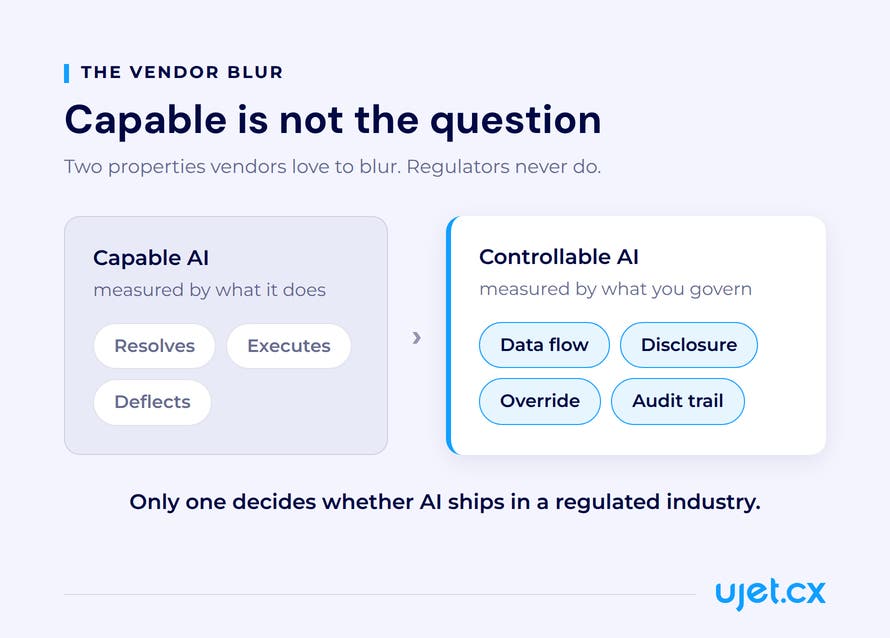
So the caution is earned. What is not earned is the conclusion most of the industry drew from it: that AI in a regulated contact center must move slowly, do little, and hide behind a human for anything that matters. That conclusion mistakes a data problem for an intelligence problem. In a regulated contact center, the real question is not whether your AI is capable. It is whether your AI is controllable.
The real risk is where your data lives
The problem: duplicate data stores
Strip any contact center AI horror story to its skeleton and you find the same structural flaw: the platform in the middle became a second system of record. Call recordings with card numbers in them. Transcripts with account details. Customer profiles duplicated out of the CRM into the CCaaS vendor's cloud so the AI has context. Every duplication is new attack surface and a new line in the audit. It is also a new place PCI DSS and GDPR obligations apply, and a new thing your AI can leak.
That is a choice, not a law of nature. It is just a choice legacy platforms made decades ago, and AI inherited it.
The solution: CRM-first architecture
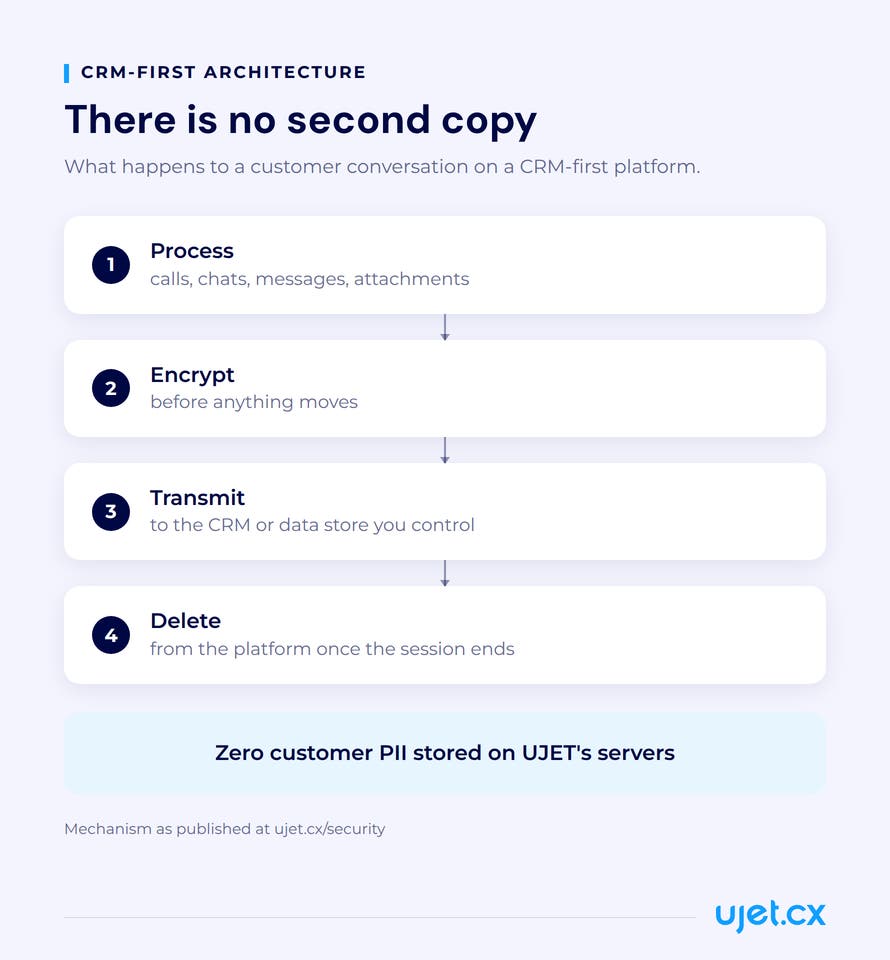
The alternative is CRM-first architecture: the contact center operates on data that lives in your CRM, and the platform in the middle stores none of it. This is how UJET is built. UJET processes customer communications, including calls, chat transcripts, messages, and attachments, encrypts them, transmits them directly to the CRM or data store you control, and deletes them from its own platform once the session ends. Zero customer PII stored on UJET's servers. The platform is certified against SOC 2 Type II and ISO 27001 with annual independent audits, alongside PCI DSS, GDPR, and HIPAA compliance.
Three things follow for a regulated operation:
-
A breach of the contact center platform cannot expose data the platform never stored.
-
The audit scope shrinks, because the regulations governing customer data attach to one system instead of two.
-
The AI layer inherits clean governance, because there is no ambiguity about where sensitive information lives or who controls it.
The compliance conversation changes shape entirely. The question is no longer "how do we protect a second copy of everything?" It becomes: there is no second copy.
The compliance-first test: six questions before any AI touches a customer
Vendor security questionnaires run two hundred rows. For a fintech or banking contact center, the decision compresses to six questions, and the red flags are as diagnostic as the answers.
|
The question |
Compliance-first architecture |
Red flag |
|---|---|---|
|
Where does customer PII live? |
In your CRM. Zero PII stored on the contact center platform |
Data duplicated to the vendor's cloud for AI context, or vague answers about secure AI partners |
|
Does the AI disclose itself? |
Disclosure by design, configurable per jurisdiction, table stakes under EU AI Act Article 50 |
Disclosure left to the operator to implement manually |
|
What governs the AI mid-interaction? |
Guardrails during the interaction: scoped actions, verified identity, supervisors who can monitor and intervene in real time |
A policy PDF, post-hoc QA sampling, and escalation paths that are fixed or delayed |
|
Can you evidence 100% of conversations? |
Every interaction analyzed and retained as a decision-grade record: what the AI said, what triggered escalation, what the human did next |
Outcome-only logging. "The model decided" is not an answer a regulator accepts |
|
What happens when the AI gets it wrong? |
A defined incident protocol: detection, correction, disclosure, and a logged record of the intervention |
No incident process. Errors surface only if a customer complains |
|
Does the governance map to a framework? |
Documentation aligned to NIST AI RMF or equivalent |
No published governance framework at all |
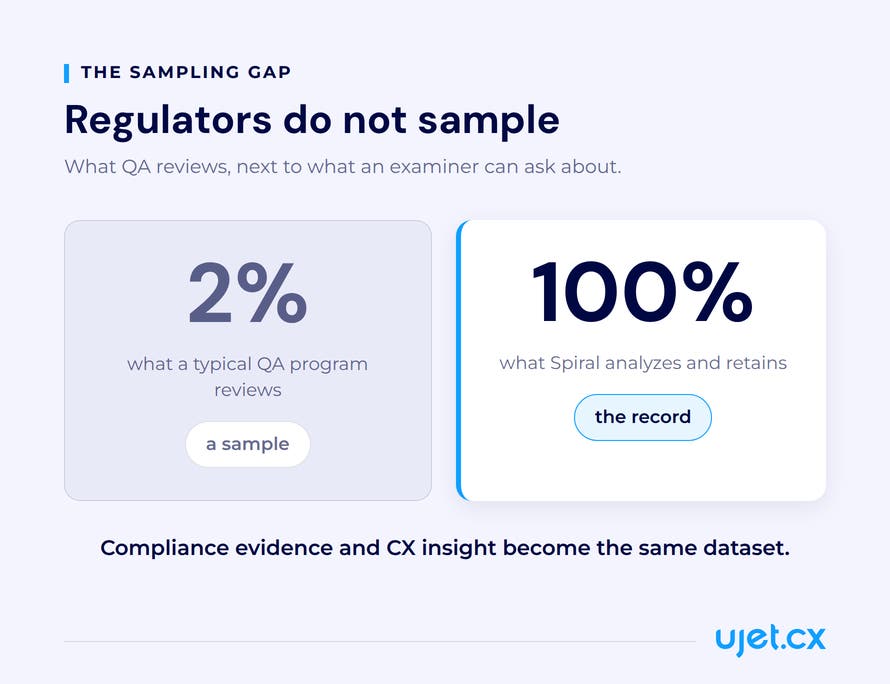
Platforms that hesitate on audit-trail depth or data residency are telling you something about their architecture. And the fourth row deserves emphasis, because it is where compliance teams have quietly accepted a standard no regulator shares. A large majority of QA programs sample a low-single-digit percentage of interactions. Regulators do not sample. When the examiner asks whether your virtual agent ever misstated a fee structure, "we reviewed 2% and found nothing" is not an answer. This is the job Spiral does: it turns 100% of calls, chats, and messages into structured, searchable intelligence, which means your compliance evidence and your CX insight are, for the first time, the same dataset.
Why are so many banks stuck piloting AI instead of scaling it?
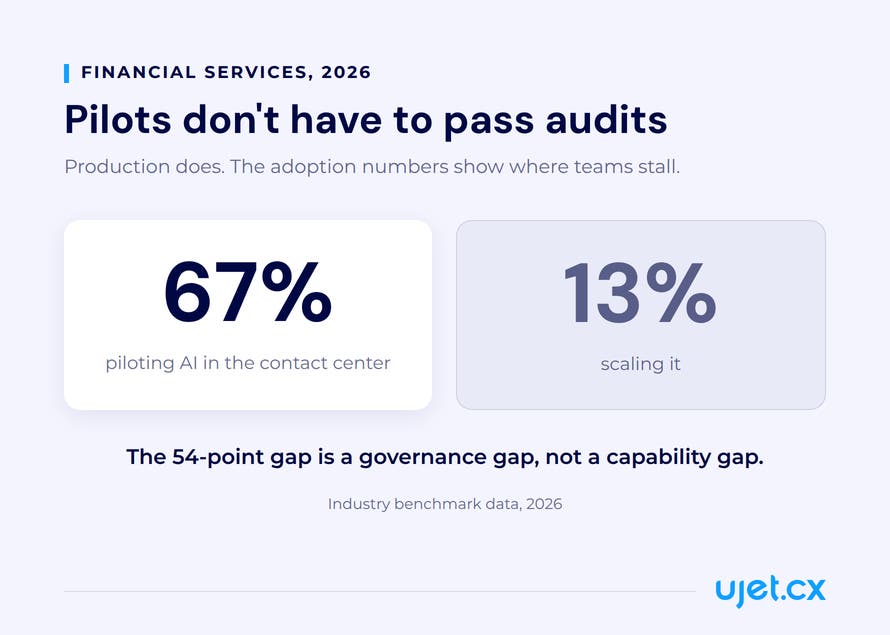
Because pilots do not have to pass audits, and production does. Industry benchmark data from 2026 shows 67% of financial services organizations actively piloting AI in their contact centers, while only 13% say they are in scaling mode. A 54-point gap between piloting and scaling is not a capability gap. It is a governance gap.
Which is what makes the deployment question ("is any of this actually live?") the most useful filter in a vendor evaluation. UJET Virtual Agent is agentic AI in production with enterprise customers today, not a roadmap item. It handles multi-turn conversations, executes workflows across integrated systems, and escalates to human agents on rules your compliance team configures, with every step logged at the conversation level. Because it runs on the same CRM-first architecture, powering the AI never requires duplicating customer data into a second system. And the next step is already in motion: AXO, Agentic Experience Orchestration, was announced in March 2026 and becomes generally available at the end of September 2026. It extends the same premise: agentic AI belongs inside governed, orchestrated guardrails during the interaction, not bolted on after it.
What does compliant AI look like in production? Ask a fintech
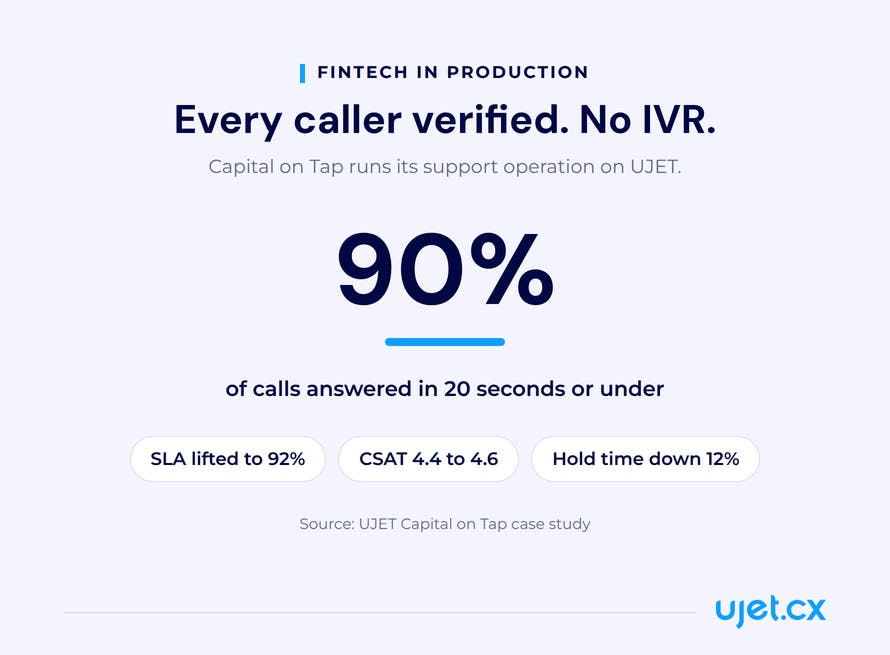
Capital on Tap, the FCA-authorized business credit card provider serving more than 200,000 small businesses across the UK and U.S., runs its support operation on UJET with a standard most banks would call impossible: answer calls in seconds, with no IVR, in a card business where every caller must be verified.
The published results: 90% of calls answered in 20 seconds or under, SLA attainment lifted to 92%, average hold time down 12%, and CSAT up from 4.4 to 4.6 in six months, with repeat contacts held under 7%.
The detail that matters for this conversation is what their team says about security. "We can easily verify callers, and that's awesome for security," as Capital on Tap's technical coordinator put it. Verification runs through the platform, powered by CRM context, without customer data pooling in a second system. And the operating philosophy from Jon Bartlett, their Head of Operations: "We continue to see the customer experience as our absolute differentiator." Not compliance or speed. An architecture where the same design decision, context from the system of record with nothing stored in the middle, produces both.
When a compliance-first platform is the right call, and when it is not
It is the right call if you are a fintech or bank running 10 to 1,000 agents, your system of record is Salesforce, ServiceNow, or a modern CRM, and your compliance team has become the place where CX projects go to die, not from obstruction, but because every new tool means a new data map. It is especially right if you are already on Google Cloud: UJET is built natively on it, so the infrastructure review covers ground your security team has likely already walked.
It is the wrong call if your data governance strategy requires the contact center platform itself to be the system of record, or if you want maximum AI autonomy with minimum disclosure, scoping, and escalation design. That is capable AI without controllable AI, and in a regulated industry, it is a liability with a demo.
The industry spent two years asking whether regulated teams can afford to deploy AI. Wrong question. The teams answering 90% of calls in 20 seconds with zero PII on the platform are asking what the compliance-as-blocker crowd is actually protecting: an architecture that was the risk all along. If your contact center AI cannot answer a regulator's questions, it cannot serve your customers at scale. The evaluation starts there.
FAQ
How do fintech and banking contact centers deploy AI compliantly?
By meeting three architectural conditions: customer PII remains in the CRM rather than being stored on the contact center platform, AI systems disclose themselves and operate inside scoped guardrails with human escalation paths, and 100% of interactions are retained and analyzable as audit evidence. Platform certifications (SOC 2 Type II, ISO 27001, PCI DSS, GDPR, HIPAA) are the floor, not the strategy.
What regulations apply to AI in banking contact centers in 2026?
In the EU, the AI Act's Article 50 transparency obligations took effect August 2, 2026, requiring that customers be informed when they interact with an AI system; broader high-risk obligations follow on December 2, 2027 and August 2, 2028. In the U.S., the CFPB has warned that chatbots providing inaccurate information or obstructing dispute rights can violate federal consumer financial law, ECOA adverse-action duties apply when AI touches credit decisions, and the NIST AI Risk Management Framework sets the de facto governance benchmark. Sector rules such as PCI DSS for payment data and GDPR for EU customer data apply the same way they apply to every other system touching that data.
What is the difference between capable AI and controllable AI?
Capable AI is measured by what it can do: resolve conversations, execute workflows, deflect volume. Controllable AI is measured by what you can govern: where the data flows, when the AI discloses itself, how a human intervenes mid-interaction, and whether every decision leaves an auditable record. In regulated industries, controllability, not capability, determines whether AI can be deployed at scale.
What is a CRM-first contact center architecture?
A CRM-first contact center architecture treats the CRM as the single system of record. The contact center platform reads customer context from the CRM in real time during an interaction and writes the outcome back, storing no customer PII itself. This eliminates the duplicate data store that legacy contact center platforms create, and with it, a large share of the breach surface and audit scope.
Does UJET store customer PII?
No. UJET stores zero customer PII on its servers. The platform processes and encrypts customer communications, transmits them directly to your CRM or the data store you control, and deletes them from UJET's platform after the session ends. UJET is certified against SOC 2 Type II and ISO 27001 with annual independent audits, maintains PCI DSS, GDPR, and HIPAA compliance, and is built natively on Google Cloud. Details at ujet.cx/security.
Does UJET have agentic AI in production today?
Yes. UJET Virtual Agent is live in production with enterprise customers, handling multi-turn conversations, executing workflows across integrated systems, and escalating to human agents on configurable rules, with conversation-level logging throughout. AXO, Agentic Experience Orchestration, was announced in March 2026 and becomes generally available at the end of September 2026.
How does a compliance team audit AI conversations at scale?
By replacing sample-based QA with full-coverage conversation intelligence. Spiral, UJET's conversational analytics AI, analyzes 100% of customer conversations and turns them into structured, decision-grade records, so questions like whether the virtual agent misstated a fee can be answered from complete data rather than a sample.
The best customer experience content delivered right to your inbox.