Stay updated!
The best customer experience content delivered right to your inbox.
AI Contact Center ROI Metrics: What Predicts and What Lies


The short answer: The contact center metrics that predict AI ROI tie activity to money: cost per resolution, first-contact resolution, repeat-contact rate, revenue per interaction, and customer lifetime value movement. The ones that don't (deflection rate, raw AHT, and containment without resolution) measure motion, not outcome.
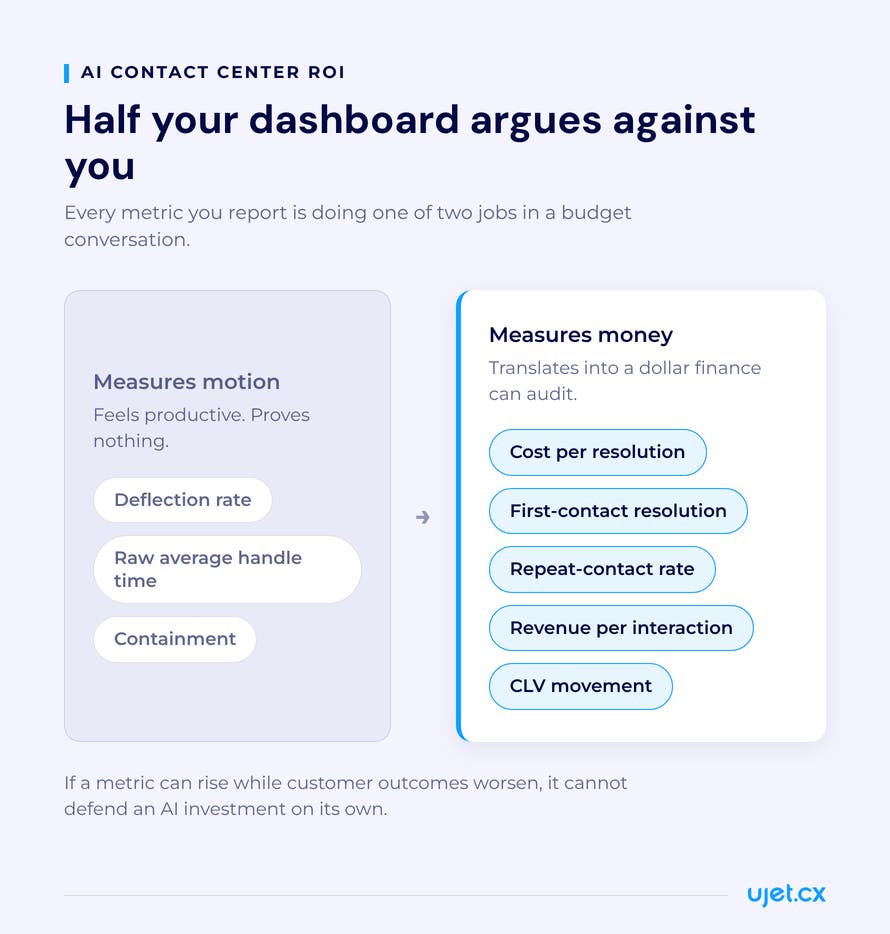
Half your dashboard is working against you in a budget conversation.
No, seriously. Contact center dashboards are full of numbers that feel productive but prove nothing. Deflection looks like efficiency. Low AHT looks like speed. High containment looks like automation success. Finance sees through all three, because none of them has a clear path to a dollar.
If a metric can rise while customer outcomes worsen, it cannot defend an AI investment on its own. Here's how to sort yours.
Key takeaways:
- Predictive ROI metrics connect directly to cost reduction, revenue contribution, or customer retention. Each one translates into a dollar figure finance can audit.
- Misleading metrics describe operational activity without a reliable link to financial outcome. Activity is what you count when you can't prove outcome.
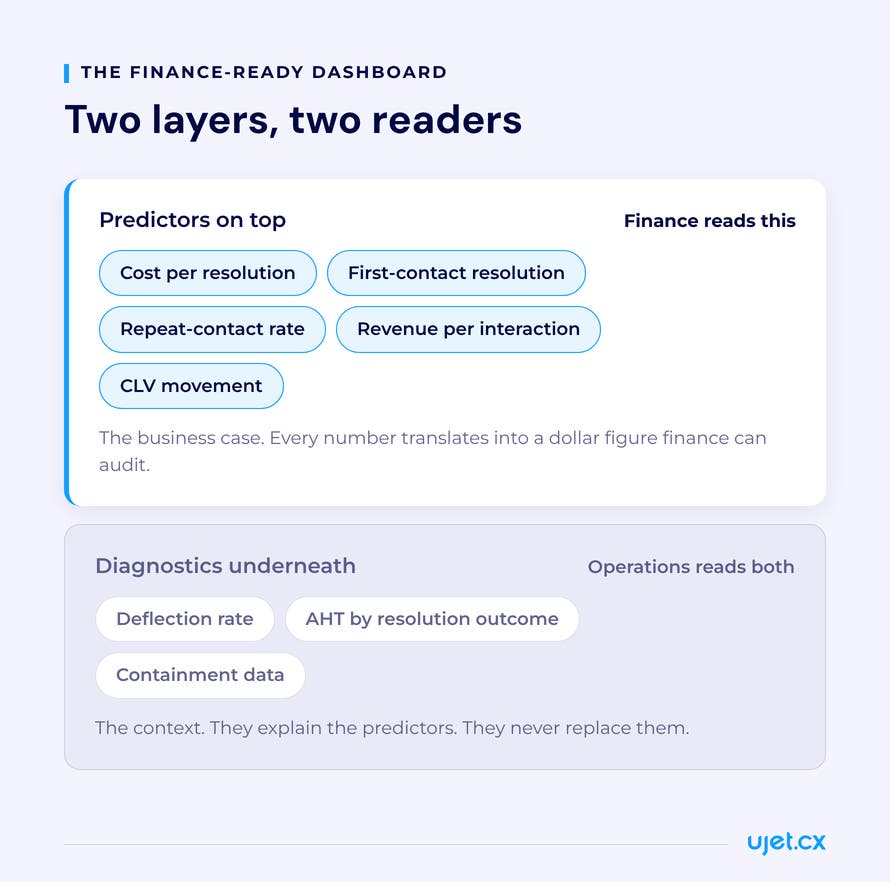
- Sort your dashboard into two layers: predictors on top as the business case, diagnostics underneath as context. Finance reads the top layer. Operations uses both.
The Best AI Contact Center ROI Metrics to Track
The best AI contact center ROI metrics connect service outcomes to financial impact:
- Cost per resolution: what it costs to actually solve an issue, not just handle a contact
- First-contact resolution (FCR): whether customers get the right answer the first time
- Repeat-contact rate: how much unresolved demand is cycling back into the queue
- Revenue per interaction: whether service conversations contribute to retention and expansion
- Customer lifetime value (CLV) movement: whether resolution quality is compounding into long-term revenue
Each gets a full breakdown below, along with the three metrics they should replace as your headline numbers.
What Makes a Metric Predict ROI? The Three-Question Test
Before sorting your metrics, run each one through three questions. Fail any of them, and the metric belongs in the diagnostic layer, not the business case.
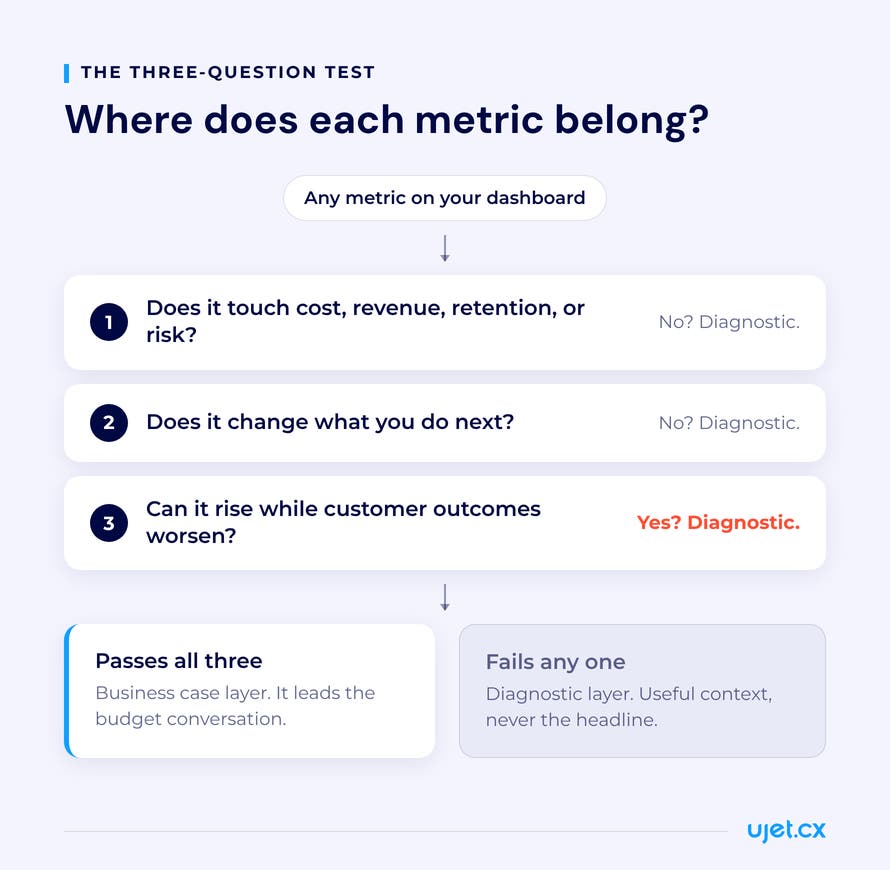
- Does it connect to cost, revenue, retention, or risk reduction? A metric that doesn't touch one of these four levers has no place in a CFO conversation. It may be useful operationally, but it cannot carry a budget justification.
- Does it improve decision quality, or just report activity? Ticket volume tells you how busy the team was. It doesn't tell you whether the work was worth doing. A metric that matters changes what you do next.
- Can it rise while customer outcomes worsen? Deflection rate can climb while unresolved demand piles up somewhere else. If the answer is yes, the metric is not a standalone ROI signal.
Pass all three, and the metric belongs in your business case. Fail one, and it still has a job as context. It just shouldn't lead the budget conversation.
Why This Test Matters for AI Contact Center Investments
AI contact center ROI depends on whether automation improves resolution, not on whether it removes interactions from the agent queue. UJET's AI-powered contact center platform is built on that principle: self-service, intelligent routing, real-time agent guidance, and CRM context all report against outcomes (first-contact resolution, cost per resolution, repeat-contact reduction), not raw activity. If your AI stack can report containment but not resolution, or handle time but not repeat contacts, it isn't giving finance the evidence it needs.
Which Contact Center Metrics Lie About ROI?
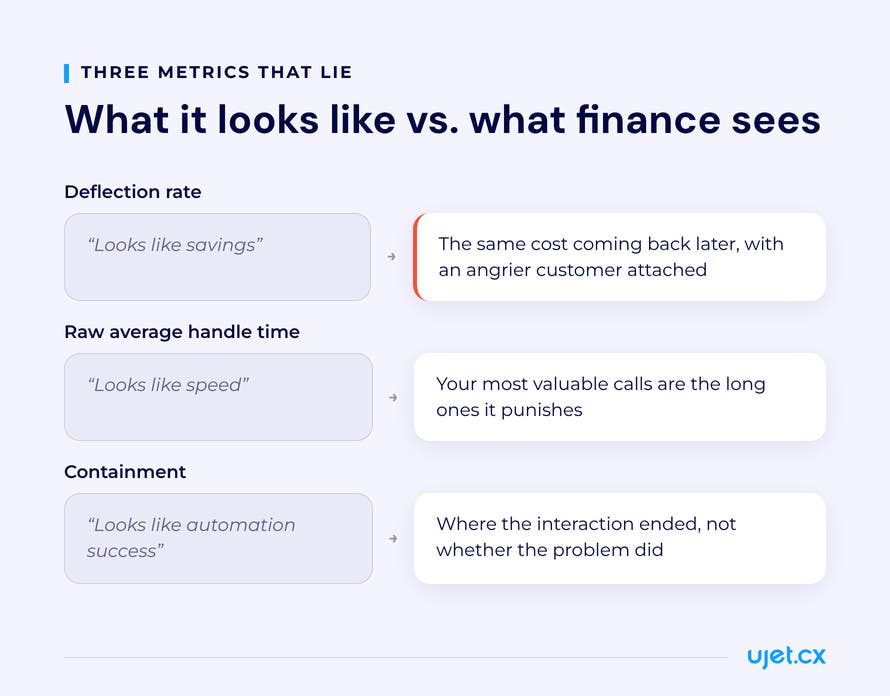
These three show up on almost every contact center dashboard. They aren't useless. They are routinely misread as proof of performance when they are proof of activity.
Deflection Rate
Why it lies: Deflection counts interactions that never reached an agent. It says nothing about whether the customer's problem got solved. A customer who abandons an IVR, closes a chatbot, and calls back an hour later just improved your deflection rate and your repeat-contact rate at the same time. We made this case on CX Today: deflection without resolution isn't savings. It's the same cost coming back later, with an angrier customer attached.
Track this instead: Containment-with-resolution rate, which counts self-service interactions that ended with a confirmed outcome, not just interactions that ended.
Raw Average Handle Time (AHT)
Why it lies: AHT rewards brevity regardless of outcome. The conversations that prevent a repeat contact, resolve a billing dispute, or save a churning customer tend to run long. Optimize for low AHT and you quietly push your best interactions out of the model. The calls that tank your AHT are frequently the ones doing the most financial work. From The Frontlines #03 breaks down exactly how, including the 25-minute healthcare retention save that wrecked an agent's dashboard for the day.
Track this instead: AHT segmented by resolution outcome. A long call that closes the issue is a different data point from a long call that ends in escalation. Averaging them hides exactly what you need to see.
Containment Without Resolution
Why it lies: Containment measures where the interaction ended, not whether the problem did. If the customer's issue went unresolved, containment is a measurement of friction, not effectiveness. Every unresolved containment event is a queued repeat contact, a likely escalation, and a churn signal.
Track this instead: Resolution rate within the automated channel, broken out by issue type, so you can see where automation genuinely works and where it's a dead end.
Which Metrics Actually Predict Contact Center ROI?
These five pass the three-question test. Each has a direct path to a financial outcome, changes what you decide next, and cannot improve while customer outcomes deteriorate.
Cost Per Resolution
Why it predicts: Cost per contact tells you what each interaction costs to handle. Cost per resolution tells you what it costs to actually solve the problem. The gap matters: cheap interactions that fail to resolve cost more in aggregate than slightly longer ones that close the issue for good. This is the one number that captures efficiency and quality at the same time.
What to track with it: First-contact resolution rate. Together they tell you whether you're getting cheaper because you're getting better, or because you're cutting corners that resurface as repeat contacts.
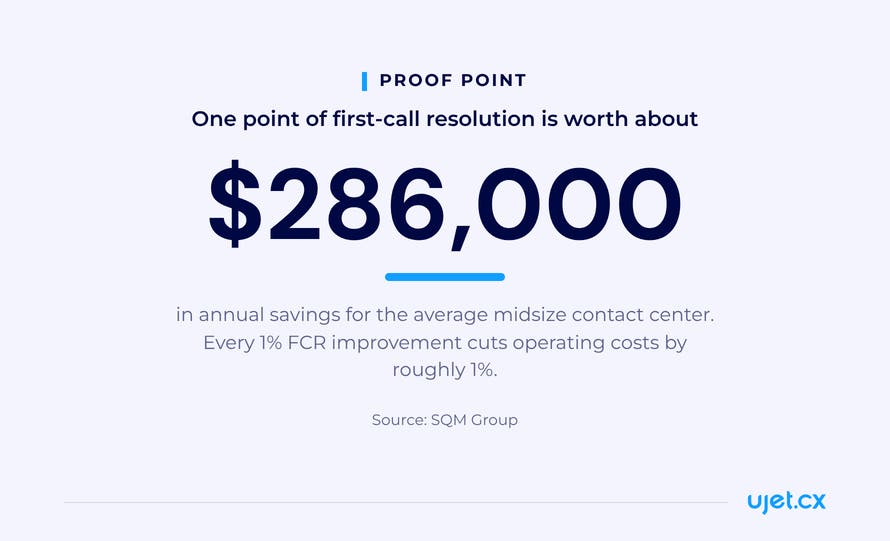
Public data point: SQM Group research shows that every 1% improvement in first-call resolution reduces operating costs by roughly 1%, about $286,000 in annual savings for the average midsize contact center. That's a dollar translation finance can verify against headcount and volume data.
First-Contact Resolution (FCR)
Why it predicts: FCR measures whether the issue was solved the first time: no repeat effort, no channel switching, no escalation. It's the clearest single signal that AI is improving the service experience rather than moving work around the system.
What to track with it: FCR by issue type, channel, and automation involvement. The goal isn't a higher global FCR. It's knowing where AI genuinely improves resolution and where it creates friction that pushes customers back into the queue.
Public data point: Aberdeen research published by UJET found that contact centers using AI-powered real-time agent guidance improved first-contact resolution 2.3x faster year over year than those without (6.3% vs. 2.8% annual improvement).
Repeat-Contact Rate
Why it predicts: Every repeat contact is two costs: the original unresolved interaction and the follow-up. Add the retention risk on top and you get one of the few CX metrics that ties operating cost and churn exposure into a single number.
What to track with it: Segment repeat contacts by issue type, channel, and agent cohort. That tells you whether the problem is a process failure, a channel gap, or a training issue.
Revenue Per Interaction
Why it predicts: Most contact centers are still measured purely as cost centers. Revenue per interaction breaks that frame. It captures upsell conversion, churn saves, and retention outcomes tied to individual interactions. That is the clearest evidence that the contact center contributes to the top line, not just the expense line.
What to track with it: Split it out across inbound service contacts, proactive outreach, and AI-assisted interactions. The comparison shows where AI is generating revenue lift versus merely shaving handle time.
Customer Lifetime Value (CLV) Movement
Why it predicts: CLV movement is the slowest metric on this list and the one leadership cares about most. It captures the compounding effect of resolution quality, repeat-contact reduction, and satisfaction on long-term revenue. This is the metric that justifies multi-year AI investment.
What to track with it: Cohort CLV by service tier and contact frequency. Customers who contact support often but get resolved fast typically retain better than customers who contact rarely and always leave unsatisfied.
Public data point: Bain & Company research by Fred Reichheld found that a 5% increase in customer retention produces a 25% or greater increase in profit. Any metric that demonstrably moves retention is moving the most important financial outcome in the business.
What the Research Says About AI Contact Center ROI
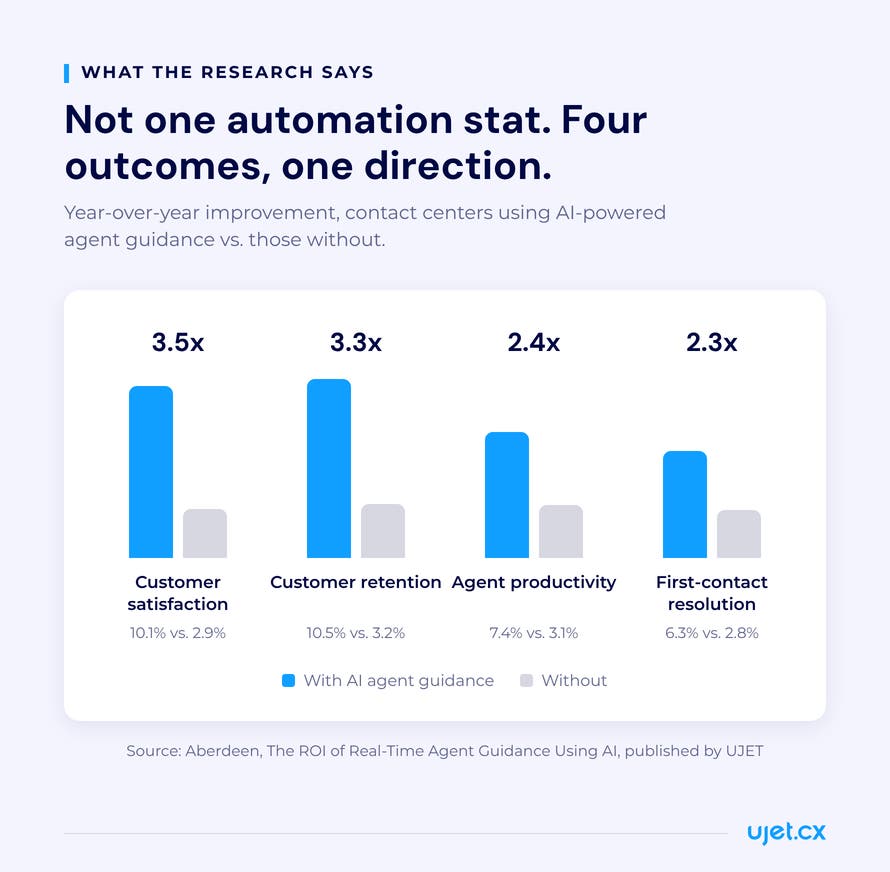
Aberdeen's The ROI of Real-Time Agent Guidance Using AI, published by UJET, compared contact centers using AI-powered agent guidance with those without. The AI group improved faster on every business-impact metric, year over year:
- 3.5x greater improvement in customer satisfaction (10.1% vs. 2.9%)
- 3.3x greater improvement in customer retention (10.5% vs. 3.2%)
- 2.4x greater improvement in agent productivity (7.4% vs. 3.1%)
- Plus the 2.3x first-contact resolution gain cited above
That's the argument to bring to finance: not one automation stat, but four outcome metrics moving in the same direction.
How Do You Build a Finance-Ready Metric Stack?
The goal is a two-layer dashboard. Predictive metrics on top: that's the business case. Operational metrics underneath: that's the diagnostic context. Finance reads the top layer. Operations uses both.
| Metric | How to translate it into dollars |
|---|---|
| Cost per resolution | Multiply the reduction in cost per resolution by monthly interaction volume → annualized savings |
| First-contact resolution | Model each 1% FCR gain as roughly 1% of operating costs (SQM benchmark) → annualized savings |
| Repeat-contact rate | Multiply repeat-contact volume by average cost per contact → avoidable spend |
| Revenue per interaction | Multiply average revenue per interaction by AI-assisted interaction volume → revenue contribution |
| CLV movement | Model a 1% retention improvement against average customer lifetime revenue → retention value |
The misleading metrics still earn their keep as diagnostics. If cost per resolution drops, AHT segmentation explains why. If repeat-contact rate improves, containment data shows whether self-service contributed. They explain the predictors. They don't replace them.
Build the Case That Holds Up
The metric stack is the tactical layer. The business case is what you build with it: a model that ties each predictor to a dollar outcome, stress-tests the assumptions, and gives finance something it can audit.
- Go deeper on the financial model: The CFO's Guide to Contact Center ROI walks the full framework: how to structure the case, which cost categories to include, and how to present AI ROI to a skeptical finance team.
- Get the number for your operation: Book an ROI review and a UJET specialist builds the model with you on your real volume, cost, and resolution data, not industry averages. (A self-serve ROI estimator lands in August.)
Frequently Asked Questions
Does AHT still matter at all?
Yes, as a diagnostic, not a headline. AHT segmented by resolution outcome is useful. Raw AHT reported to finance without resolution data is a number that can look good while service quality deteriorates.
What is the difference between containment and resolution?
Containment means the interaction stayed in the automated channel. Resolution means the customer's problem was actually solved there. An interaction can be contained without being resolved, and unresolved containment is the most expensive kind because it comes back.
What if revenue per interaction is hard to measure?
Start with churn saves and upsell conversions; your CRM likely tracks both already. Assign a dollar value to each based on average contract value or customer lifetime revenue. A rough model beats no revenue attribution.
How do I present CLV movement when leadership wants faster proof?
Lead with repeat-contact rate and cost per resolution for the near-term case. Frame CLV movement as the 12-to-24-month validation metric. Leadership that approves AI investment on short-term savings will want long-term retention proof to justify renewal.
Should deflection rate ever be reported?
Report it alongside containment-with-resolution rate so the two numbers contextualize each other. Deflection alone is not a performance metric. Deflection with confirmed resolution is.
What AI contact center metrics matter most to finance?
The ones that translate into cost, revenue, retention, or risk: cost per resolution, first-contact resolution, repeat-contact rate, revenue per interaction, and CLV movement. Deflection and containment describe activity, not financial outcomes.
How does AI improve first-contact resolution?
Four ways: resolving routine issues fully in self-service, routing complex issues to the right agent sooner, giving agents real-time context and next-best actions mid-interaction, and removing the need for customers to repeat information across channels.
What is the difference between cost per contact and cost per resolution?
Cost per contact measures what it costs to handle an interaction. Cost per resolution measures what it costs to solve the problem. A cheap unresolved contact is usually the most expensive kind because it comes back.
Sources and References
- SQM Group — First Call Resolution: A Comprehensive Guide
- Bain & Company — Prescription for Cutting Costs (Fred Reichheld)
- CX Today — The Deflection Trap: Why Routing Metrics Don't Equal Resolution
- UJET — The CFO's Guide to Contact Center ROI in 2026
- From The Frontlines #03 — The Best Calls Tank Your AHT (UJET Substack)
- Aberdeen — The ROI of Real-Time Agent Guidance Using AI, published by UJET
The best customer experience content delivered right to your inbox.
About the authors