Stay updated!
The best customer experience content delivered right to your inbox.
Telehealth Contact Centers in 2026: Why Legacy Voice Tools Are Breaking Patient Relationships


The five-question test for the best contact center platform for telehealth and HIPAA-adjacent CX
TL;DR: The best contact center platform for telehealth is defined by architecture, not features: zero patient PII stored on the platform (CRM-first), HIPAA-grade certification with biometric verification, digital channels that blend with voice, and AI whose every interaction is retained as auditable evidence. Legacy voice systems fail all four.
The best contact center platform for telehealth stores no patient PII, verifies identity biometrically instead of by interrogation, meets patients on digital channels that blend into voice, and makes 100% of conversations auditable. That is an architecture standard, not a feature list, and it is exactly where legacy voice tools break.
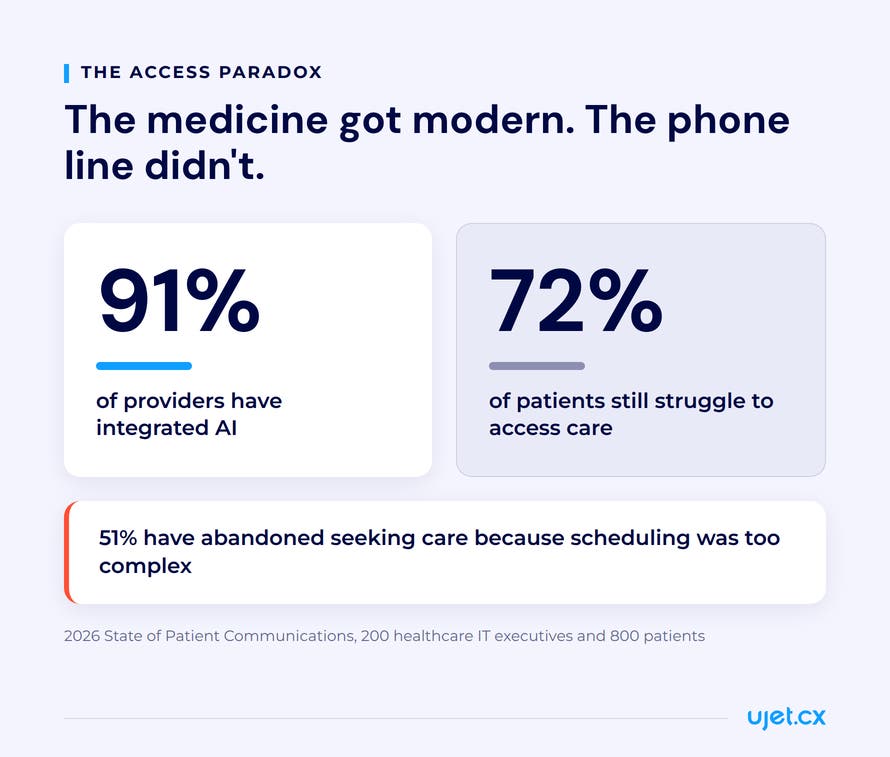
Here is the paradox nobody in healthcare wants to say out loud: 91% of healthcare providers have integrated AI into their workflows, and 72% of patients still struggle to access care. Same survey, same year, the 2026 State of Patient Communications study of 200 healthcare IT executives and 800 patients. More than half of patients, 51%, have abandoned seeking care entirely because the scheduling process was too complex. The medicine got modern. The phone line didn't.
The relationship is breaking at the front door, not in the visit
Telehealth itself is doing fine. It has settled into normal: telehealth utilization grew 10.1% between Q4 2025 and Q1 2026, reaching 5.51% of all U.S. medical claim lines, with 18.4% of patients having a telehealth claim, per FAIR Health's quarterly tracker. The regulatory floor stabilized too, after two lapses during the shutdown winter, Medicare telehealth flexibilities were extended through December 31, 2027 in the appropriations act signed February 3, 2026. The visit is not the problem.
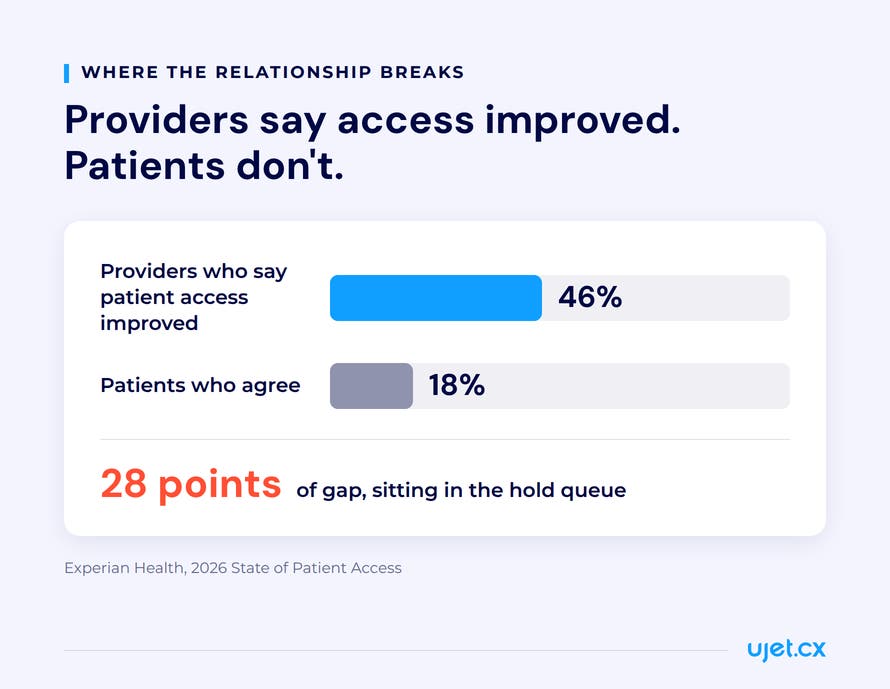
The problem is everything wrapped around the visit. Experian Health's 2026 State of Patient Access found that 46% of providers believe patient access improved over the last year. Only 18% of patients agree. That 28-point perception gap lives in specific places: the hold queue, the seven identity questions before anyone helps you, the portal password reset that routes back to the same hold queue.
And patients do not file complaints about it. They leave. Roughly one in five consumers switched healthcare providers in a recent year, and nearly 90% of those who left said they did so because the organization was hard to do business with. Not clinical quality. Administration. The same friction shows up upstream of revenue as no-shows: 27% of medical practices said no-show rates rose again in 2025, and the practices that held steady credited exactly the unglamorous fixes, automated reminders, two-way texting, easy self-rescheduling, per MGMA.
Why legacy voice tools can't just be patched
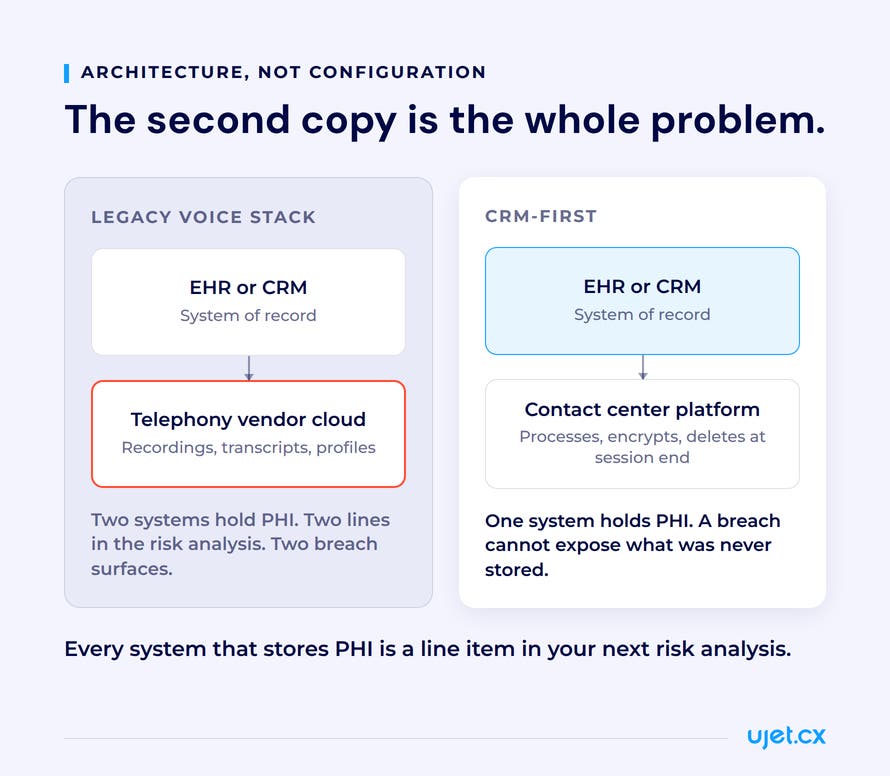
Strip down any legacy healthcare contact center and you find the same structural flaw the fintech world is now paying for: the platform in the middle became a second system of record. Call recordings with member IDs in them. Transcripts with diagnoses. Patient profiles duplicated out of the EHR or CRM into a telephony vendor's cloud. In healthcare, that second copy isn't just attack surface, it's PHI, and it sits squarely inside HIPAA's blast radius.
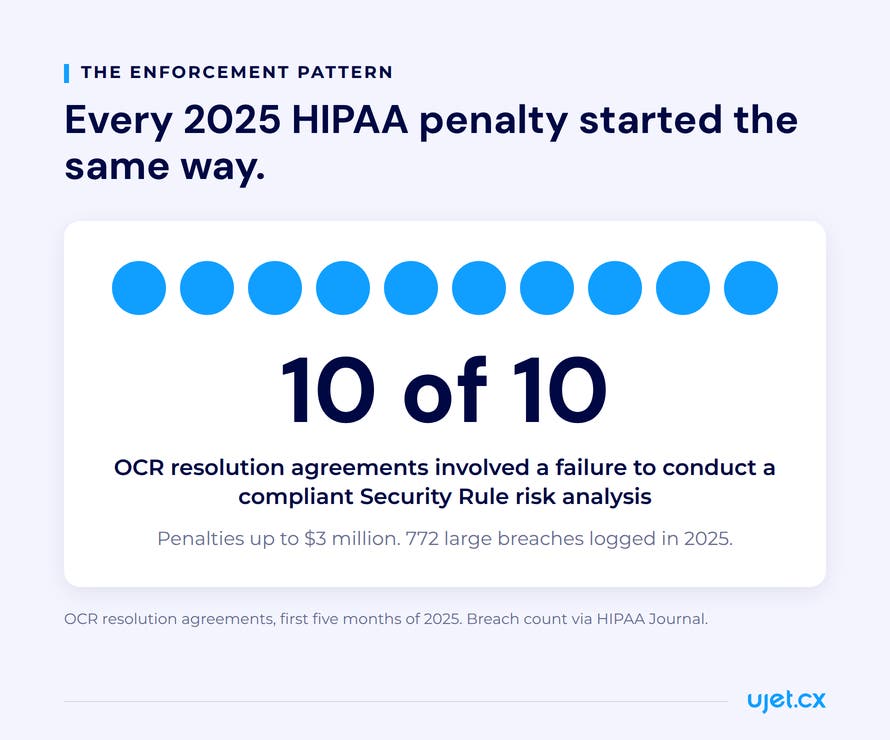
The enforcement climate makes this a present-tense problem. OCR announced ten HIPAA resolution agreements in the first five months of 2025 alone, with penalties up to $3 million, and every single one involved a failure to conduct a compliant Security Rule risk analysis. The breach portal logged 772 large breaches in 2025, with the PHI of more than 100 million individuals exposed in each of the last three years, per the HIPAA Journal. Meanwhile the proposed HIPAA Security Rule update, published January 2025 with a final rule now overdue, signals that the compliance bar is moving up, not down. Every system that stores PHI is a line item in your next risk analysis. The cheapest line item is the one that isn't there.
That is the argument for CRM-first architecture. UJET processes patient communications, calls, chats, messages, attachments, encrypts them, transmits them to the CRM or data store the provider controls, and deletes them from its own platform when the session ends. Zero patient PII stored on UJET's servers. Identity verification runs through smartphone biometrics, fingerprint or Face ID, instead of a quiz about your mother's maiden name, on a platform certified against SOC 1 and SOC 2 Type II, HIPAA, PCI DSS, and ISO 27001 with annual independent audits.
Three things follow. A breach of the contact center cannot expose records the platform never stored. The HIPAA risk analysis shrinks, because PHI attaches to one system instead of two. And the AI layer inherits clean governance, because there is no ambiguity about where patient data lives.
Meet patients where they already are: everywhere but hold music
The channel mismatch is generational and it is measurable. 80% of patients want to schedule appointments anytime, from home or a mobile device, yet only 54% of providers offer self-scheduling, per Experian Health. And the front door is moving again: 32% of U.S. adults used AI chatbots for health information in 2025, double the year before, 45% of Gen Z and 48% of millennials, per Rock Health. Phone-only access is a policy decision to be hard to reach.
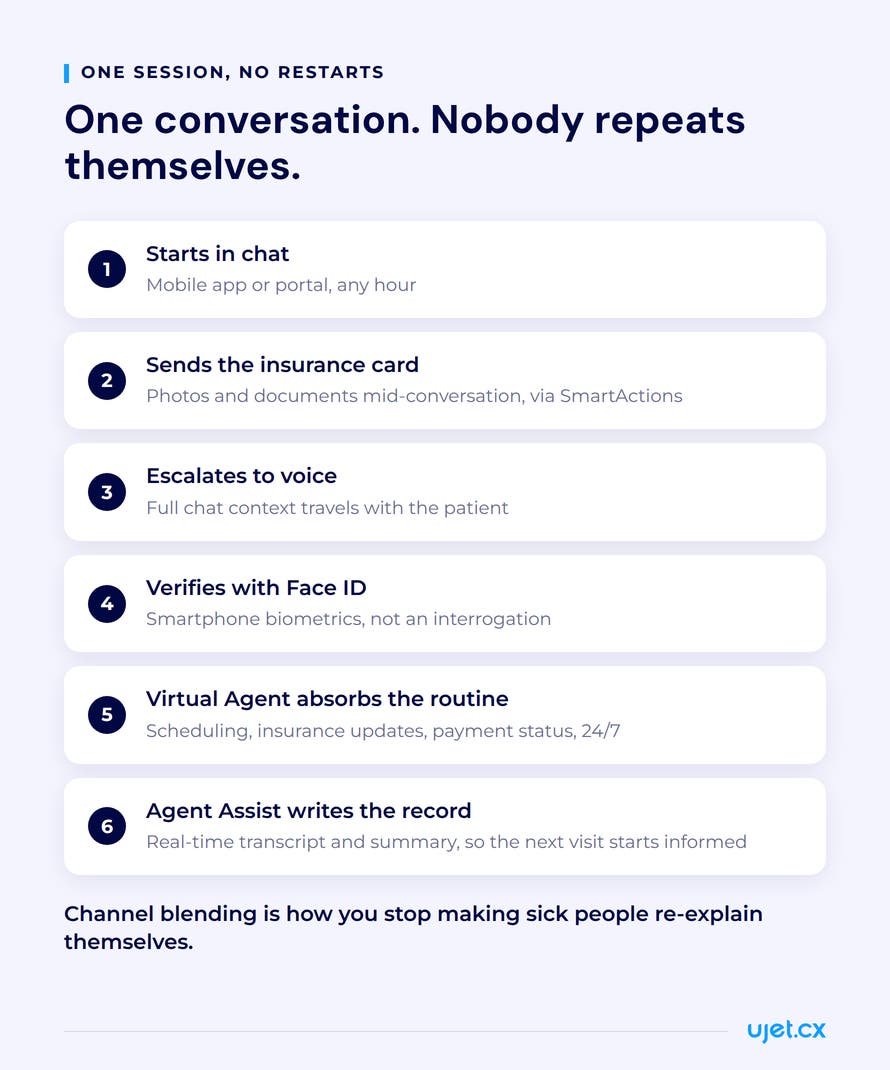
What this looks like on a modern platform: a patient starts in chat, sends a photo of their insurance card or prescription mid-conversation via SmartActions, escalates to voice without repeating themselves, and verifies with Face ID instead of an interrogation. A Virtual Agent handles the volume that never needed a human, symptom screening intake, appointment requests and rescheduling, billing address changes, insurance updates, payment status, 24/7, and hands off to an agent with full context when judgment is needed. Agent Assist transcribes and summarizes in real time so the next agent, and the next visit, starts informed. Channel blending isn't a convenience feature in healthcare; it is how you stop making sick people re-explain themselves.
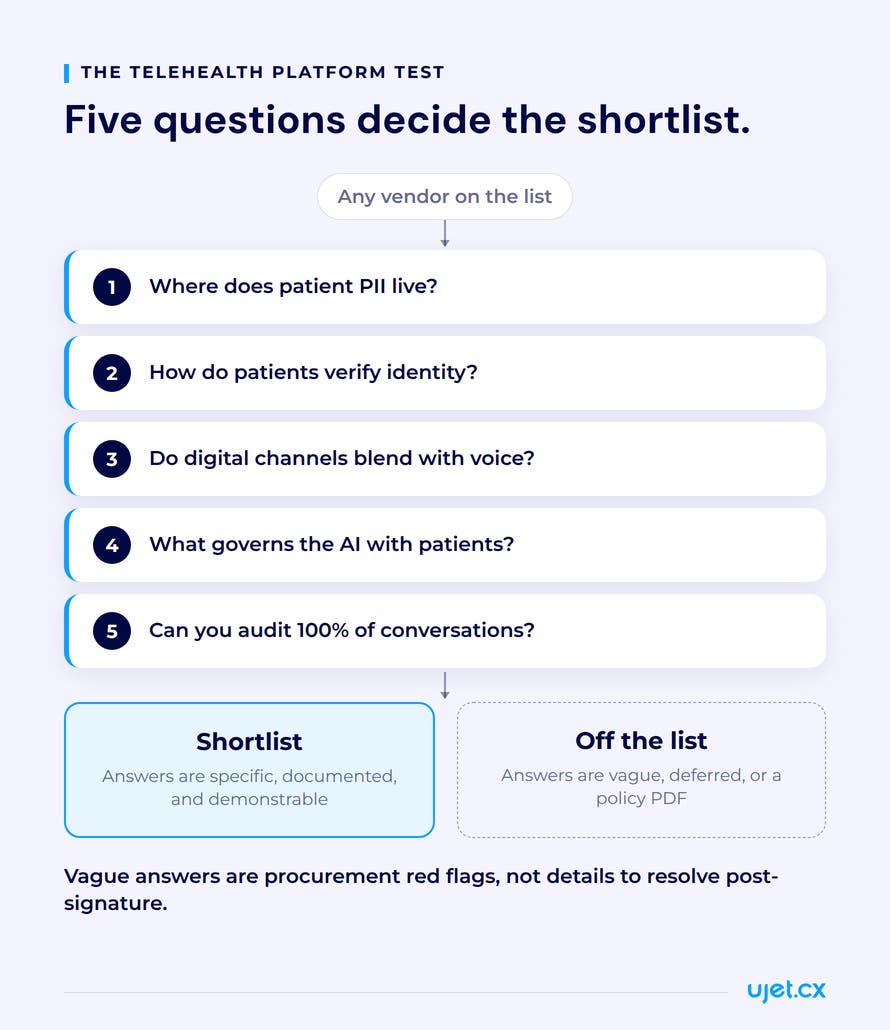
The telehealth platform test: five questions
Vendor evaluations in healthcare run long because the stakes run high. They compress to five questions. Use the table as a working document in vendor conversations, vague answers are procurement red flags, not details to resolve post-signature.
|
The question |
What good looks like |
Red flag |
Why it matters |
|---|---|---|---|
|
Where does patient PII live? |
In your CRM/EHR-adjacent system of record. Zero PHI stored on the contact center platform |
Recordings and transcripts retained in the vendor's cloud "for AI training," or vague retention answers |
Every system that stores PHI is a line item in your HIPAA risk analysis, and every 2025 OCR resolution agreement involved a risk-analysis failure |
|
How do patients verify identity? |
Smartphone biometrics; knowledge questions as fallback, not default |
Password + interrogation as the only path, friction that drives abandonment |
Knowledge-based authentication is both the slowest step in patient access and the one most exposed to social engineering |
|
Do digital channels blend with voice? |
Chat to voice escalation with context carried; photos and documents shared mid-interaction |
Separate tools per channel; patients repeat themselves at every hop |
80% of patients want to self-serve from a mobile device; only 54% of providers let them. Every handoff without context is a place patients drop out |
|
What governs the AI with patients? |
Scoped actions, disclosure, instant human escalation, supervisor visibility mid-interaction |
A policy PDF and a prayer; escalation paths that are fixed or delayed |
AI governance is only as clean as the data boundaries underneath it. Retrofitting controls onto distributed PHI doesn't work |
|
Can you audit 100% of conversations? |
Every interaction retained and analyzable as a decision-grade record |
QA sampling a low-single-digit percentage and calling it oversight |
Regulators, plaintiffs' attorneys, and CMS auditors do not sample. If your QA program does, your compliance evidence and your actual operations are two different datasets |
The fifth row is where healthcare quietly runs the biggest gap between what compliance assumes and what operations does. Most QA programs sample a sliver of interactions. This is the job Spiral does: it turns 100% of calls, chats, and messages into structured, searchable intelligence, which means your compliance evidence and your patient-experience insight become the same dataset. And note the dependency: analyzing 100% of patient conversations is only responsible on an architecture that stores none of the underlying PII. Full-coverage analytics on a platform that hoards PHI just builds a bigger honeypot.
How to actually run the evaluation
The five questions work best when they align stakeholders before the shortlist exists, not after. Get IT, compliance, operations, and patient access in the same room with the same criteria and the evaluation stops being four departmental checklists.
-
Map your current data flows before the first vendor call. Know where PHI lives across your stack today. That map is the baseline for judging what any vendor's architecture would actually change.
-
Ask vendors to show, not tell. Request a data flow diagram: where patient data is processed, where it is stored, when it is deleted. "Secure cloud storage" is not an answer.
-
Treat retention and AI-training policies as procurement criteria. If a vendor retains interaction data to train models, that data is PHI. It needs a BAA, a risk analysis entry, and a governance plan, before signature, not after.
-
Test identity verification in the demo. Time it. Knowledge-based authentication that runs 90 seconds is friction with a measurable abandonment cost. Biometric verification that runs five seconds is not.
-
Ask for audit coverage numbers, not QA process descriptions. "We have a robust QA program" is not a number. "We analyze 100% of interactions" is. Then ask what the output looks like and who can query it.
-
Verify certifications with documentation. HIPAA, SOC 2 Type II, and ISO 27001 should arrive as audit reports with annual independent review, not as logos on a slide.
Surface-level feature comparison can happen after that filter. Not before.
What the evidence says this is worth
The proof pattern in healthcare CX is consistent across independent benchmarks: friction is the leak. Industry benchmarks put average healthcare call center hold at 4.4 minutes against a 50-second target, with abandonment around 7% and spiking past 10% at peak, and every abandoned call in a scheduling queue is revenue walking out the door quietly. On the platform side, the verified reviewer evidence points the same direction. As one technical coordinator put it in a verified G2 review of UJET: "We love that customers can send us screenshots or videos so we can have more information about the issues they are experiencing. We can easily verify callers as well and that's awesome for security."
Healthcare organizations moving off legacy voice tools are not chasing a shinier phone system. They are removing the last pre-digital layer between a patient and their care, and doing it on an architecture that gets safer as it gets smarter. With agentic AI moving from pilots to production across the industry (healthcare AI spending nearly tripled to $1.4B in 2025, per Menlo Ventures), the platforms that can prove control, not just capability, will be the ones compliance teams approve. UJET Virtual Agent is that model in production today, and AXO, Agentic Experience Orchestration, announced for general availability at the end of September 2026, extends it: agentic AI operating inside governed guardrails during the interaction, not bolted on after it.
The shortlist standard
A telehealth contact center platform earns its place on the shortlist when it can demonstrate all five:
-
Zero patient PII stored on the contact center platform
-
Identity verified through smartphone biometrics, not interrogation
-
Digital and voice channels blended so patients never repeat themselves
-
AI governed with scoped actions, disclosure, and instant human escalation
-
100% of conversations retained as auditable, structured records
UJET is built on this model. Healthcare organizations evaluating a replatform can talk to our team about how the architecture maps to their specific EHR and CRM environment.
FAQ
What contact center platform is best for telehealth and HIPAA-adjacent CX?
The best telehealth contact center platform meets four architectural conditions: it stores zero patient PII (CRM-first data flow with deletion after each session), it is certified against HIPAA, SOC 2 Type II, and ISO 27001, it blends digital channels with voice so patients never repeat themselves, and it retains 100% of interactions as auditable records. UJET is built on this model, no PHI stored, biometric verification, and Spiral analyzing every conversation.
How should we evaluate a telehealth contact center platform?
Ask five architectural questions before comparing features: where patient PII lives, how patients verify identity, whether digital channels blend into voice with context preserved, what governs AI during patient interactions, and whether the organization can audit 100% of conversations. Map your current data flows first, require a data flow diagram from each vendor, and treat retention and AI-training policies as procurement criteria rather than post-signature details.
Does UJET store patient PHI?
No. UJET processes and encrypts patient communications, transmits them to the CRM or data store the healthcare organization controls, and deletes them from its own platform after the session ends. Zero patient PII is stored on UJET's servers. UJET maintains HIPAA compliance alongside SOC 1 and SOC 2 Type II, PCI DSS, and ISO 27001 certifications, with annual independent audits.
How do patients verify identity without passwords?
Through smartphone biometrics, fingerprint or Face ID, via UJET's mobile SDK and SmartActions. Biometric verification is faster than knowledge-based questioning, harder to compromise than passwords, and reduces the interrogation friction that drives call abandonment in patient access.
What can a Virtual Agent handle in a telehealth contact center?
Symptom screening intake, appointment scheduling and rescheduling, billing address and insurance information updates, payment status checks, and account questions, 24/7, with escalation to human agents that carries full conversation context. Specialized Virtual Agents can be configured for more complex flows like pre-visit preparation.
How does a healthcare compliance team audit AI conversations at scale?
By replacing sample-based QA with full-coverage conversation intelligence. Spiral, UJET's conversational analytics AI, analyzes 100% of patient conversations and turns them into structured, decision-grade records, so questions like "did the virtual agent give accurate billing information" are answered from complete data, not a 2% sample.
Are Medicare telehealth flexibilities still in effect in 2026?
Yes. After briefly lapsing during the government shutdown and again on January 31, 2026, Medicare telehealth flexibilities were extended through December 31, 2027 by the 2026 Consolidated Appropriations Act, signed February 3, 2026. The extension gives providers a stable planning horizon for telehealth-adjacent CX investment.
The best customer experience content delivered right to your inbox.
About the authors